

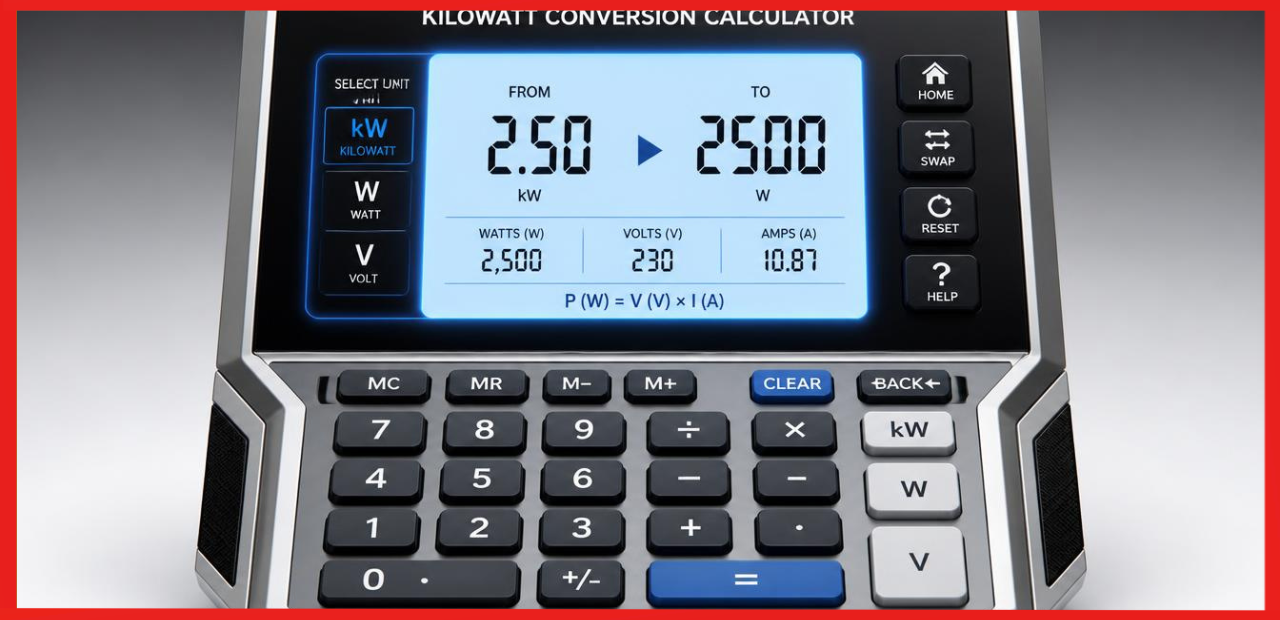
There’s a funny little moment that happens when someone first hears the word kilowatt. They nod, smile a bit, and secretly hope nobody asks what it actually means.
I know because I did exactly that years ago while standing next to an electrician who casually tossed around numbers like they were confetti.
“It’s only a few kilowatts,” he said, and I replied with a confident “Right, makes sense,” while my brain quietly wandered off looking for a dictionary.
Funny enough, once you understand Kilowatt Conversion Calculator tools, everything starts fitting together almost too neatly, even if the first few steps feels a tiny bit confusing.
Whether you’re a homeowner trying to understand electricity bills, a student studying Electrical engineering, or simply someone comparing appliance ratings before buying a new air conditioner,
knowing how Power conversion works saves time, avoids mistakes, and makes technical numbers feel surprisingly friendly.
Numbers don’t suddenly become less intimidating, but they do become a little more willing to shake your hand.
| Convert From | Convert To | Conversion Formula |
|---|---|---|
| Kilowatts (kW) | Watts (W) | W = kW × 1,000 |
| Kilowatts (kW) | Megawatts (MW) | MW = kW ÷ 1,000 |
| Kilowatts (kW) | Gigawatts (GW) | GW = kW ÷ 1,000,000 |
| Kilowatts (kW) | Horsepower (hp) | hp = kW × 1.34102 |
| Kilowatts (kW) | BTU/hour | BTU/hr = kW × 3,412.14 |
| Kilowatts (kW) | Kilowatt-hours (kWh)* | kWh = kW × Hours |
| Watts (W) | Kilowatts (kW) | kW = W ÷ 1,000 |
| Megawatts (MW) | Kilowatts (kW) | kW = MW × 1,000 |
| Gigawatts (GW) | Kilowatts (kW) | kW = GW × 1,000,000 |
| Horsepower (hp) | Kilowatts (kW) | kW = hp × 0.7457 |
What Is a Kilowatt Conversion Calculator?
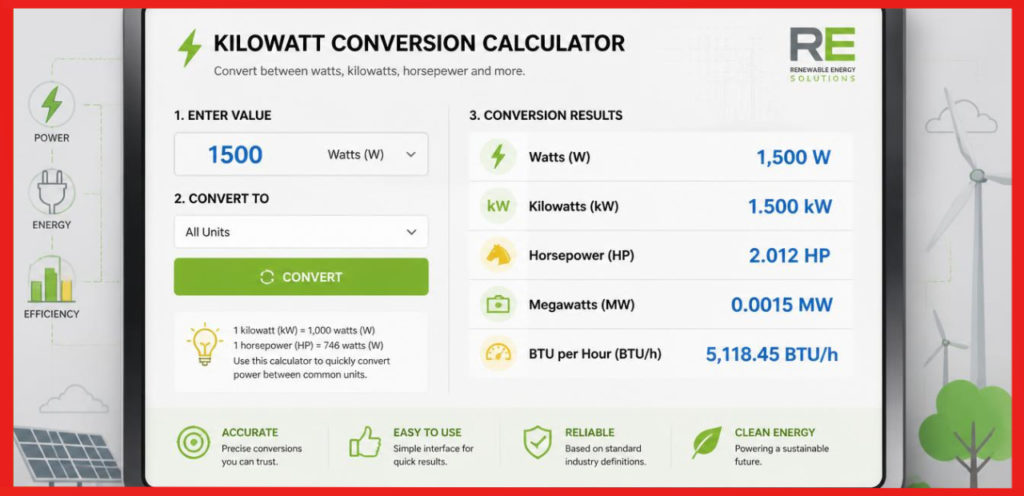
A Kilowatt Conversion Calculator is an Electrical calculator designed to convert Kilowatt (kW) values into many other Power units using accurate Conversion factors.
Instead of manually applying formulas every single time, the calculator performs instant Unit conversion between commonly used electrical and mechanical measurements.Think of it like translating languages.
Just as one sentence can be spoken in English, Spanish, or Japanese while keeping the same meaning, one amount of Electrical power can be expressed in Watts, Horsepower, Megawatts, or dozens of other units.
The value changes, the actual amount of Power does not. That tiny realization kinda changes everything.
Some of the most common conversions include:
- Kilowatts to watts
- Kilowatts to microwatts
- Kilowatts to milliwatts
- Kilowatts to megawatts
- Kilowatts to horsepower
- Kilowatts to BTU per hour
- Kilowatts to kilocalories per hour
- Kilowatts to amperes
- Kilowatts to kilovolt-amperes
- Kilowatts to volt-amperes
- Kilowatts to kilowatt-hours
Understanding the Kilowatt Before Using Any Kilowatt Conversion Calculator
A Kilowatt belongs to the family of SI Units, specifically an SI derived unit used for measuring Electrical power.
One Kilowatt (kW) equals:
- 1,000 watts
- 1,000 joules per second
- One thousand times the base Watt (W) thanks to the Metric prefix Kilo (10³)
That little prefix “kilo” simply means one thousand. Same idea appears in kilograms, kilometers and kiloliters. Somehow our brains accepts kilometers instantly but becomes suspicious when electricity gets involved. Strange, isn’t it?
Since the Metric system is internationally standardized, engineers, electricians, manufacturers, and researchers all rely on this measurement for consistent Scientific measurements and Engineering calculations.
Why Power Conversion Matters More Than You Think
Imagine buying a generator manufactured in Europe.
The manual lists the output in Kilowatt (kW).
Your contractor talks in Horsepower (hp).
Your HVAC installer prefers BTU per hour (Btu/h).
Your utility company bills in Kilowatt-hours (kWh).
Nobody is technically wrong. They’re simply speaking different measurement languages.
That’s exactly where Power conversion formulas, Conversion tables, and Electrical conversion calculators become valuable.
Without reliable conversions, comparing equipment becomes difficult, calculations become error-prone, and sizing electrical systems turns into guesswork. Guesswork and electricity usually dont make very good friends.
Common Units Converted Using a Kilowatt Conversion Calculator
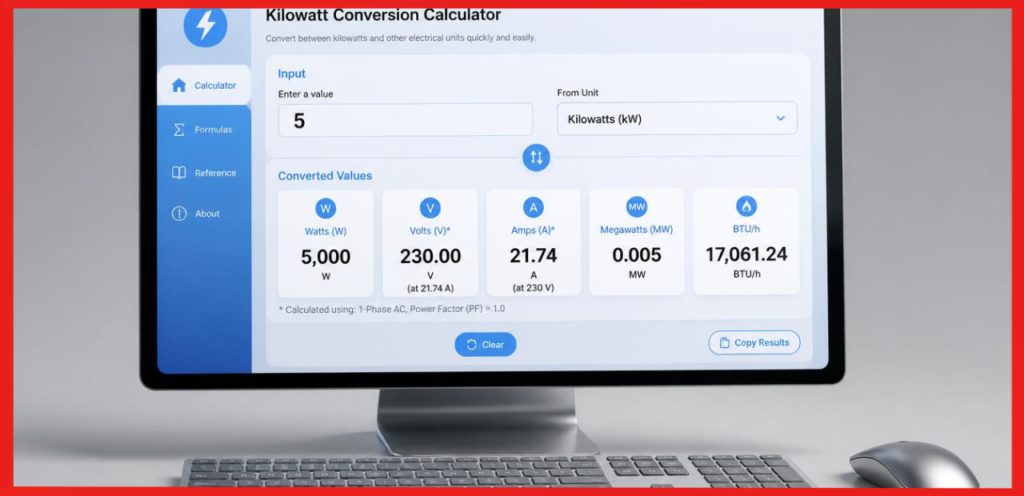
A quality Power unit calculator usually supports dozens of measurements.
SI Power Units
These belong to the Metric system and are widely used throughout science and engineering.
- Microwatt (µW)
- Milliwatt (mW)
- Watt (W)
- Kilowatt (kW)
- Megawatt (MW)
These units represent different scales of exactly the same thing Power measurement.
Mechanical Power Units
Many engines still use traditional measurements.
Examples include:
- Horsepower (hp)
- Mechanical power ratings
Car engines, pumps, compressors and industrial machines often continue using Horsepower, especially within US customary units and Imperial units.
Heating Units
Heating and cooling industries frequently use:
- BTU per hour (Btu/h)
- Kilocalories per hour (kcal/h)
These help describe heating output instead of direct electrical measurements.
Electrical System Units
Electricians regularly convert Kilowatt values into:
- Kilovolt-amperes (kVA)
- Volt-amperes (VA)
- Amperes (A)
These calculations often depend on voltage and power factor as well.
Basic Power Conversion Formula
Although calculators simplify everything, understanding the formulas builds confidence.
Some common equations include:
Kilowatts to Watts
1 kW = 1,000 W
Kilowatts to Megawatts
MW = kW ÷ 1,000
Kilowatts to Milliwatts
mW = kW × 1,000,000
Kilowatts to Microwatts
µW = kW × 1,000,000,000
Each equation uses a different Conversion factor, yet all preserve the same amount of Electrical power.
Kilowatt Conversion Calculator for Everyday Life
Most people unknowingly interact with kilowatts almost every day.
Here are common examples.
A home air conditioner may consume around 2–5 kW.
An electric oven often operates between 2 and 4 kW.
A microwave usually ranges from 0.7 to 1.5 kW.
Electric vehicle chargers can exceed 7 kW.
Industrial machinery may require hundreds of kilowatts.
Large wind turbines operate in multiple Megawatts (MW).
It’s kinda funny how your phone charger whispers in watts while an entire factory shouts in megawatts, yet both obey exactly the same mathematical rules.
Quick Conversion Table
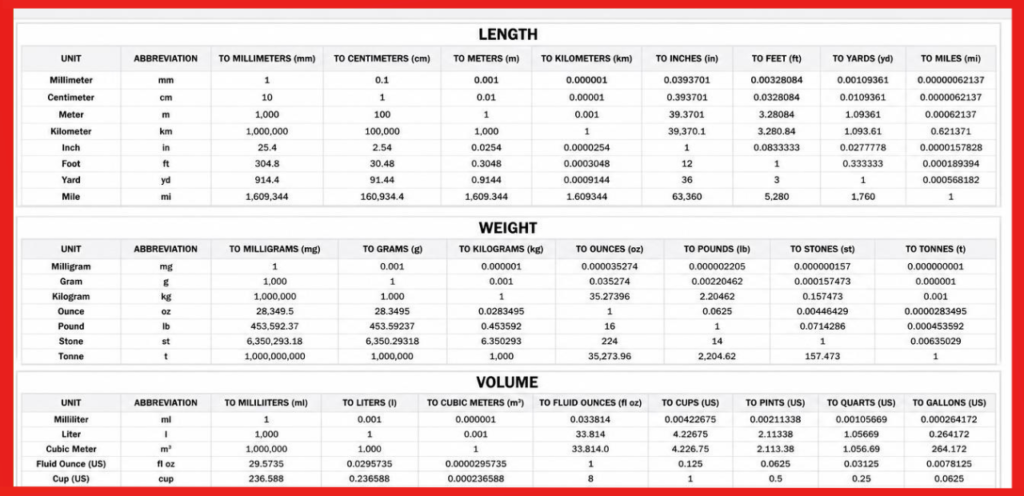
Here’s a simple Conversion reference table for frequently used values.
| Kilowatt | Equivalent Value |
|---|---|
| 0.001 kW | 1 W |
| 0.5 kW | 500 W |
| 1 kW | 1,000 W |
| 2 kW | 2,000 W |
| 5 kW | 5,000 W |
| 10 kW | 10,000 W |
| 1000 kW | 1 MW |
A good Power conversion table allows engineers and students to estimate values instantly without repeatedly entering numbers.
Kilowatt Conversion Calculator in Engineering Projects
Professional engineers rarely depend on memory alone.
Instead, they use Engineering calculator software and verified Electrical engineering calculator tools during:
- Designing electrical systems
- Industrial automation
- Generator sizing
- Solar power installations
- HVAC calculations
- Manufacturing plants
- Electrical load calculation
- Equipment specification reviews
Accuracy matters because even a small error can affect efficiency, equipment safety, or installation costs. Tiny mistakes sometimes wear very expensive shoes.
Understanding Energy Consumption vs Power
People often confuse Power with energy.
Here’s the difference.
Power measures how quickly energy is used.
Energy measures how much total energy has been consumed over time.
For example:
A heater rated at 2 kW running for 3 hours uses:
2 × 3 = 6 Kilowatt-hours (kWh)
Notice how Kilowatt-hours (kWh) represent energy, not power.
That’s why electricity bills are measured in kWh rather than kW.
Popular Conversion Types
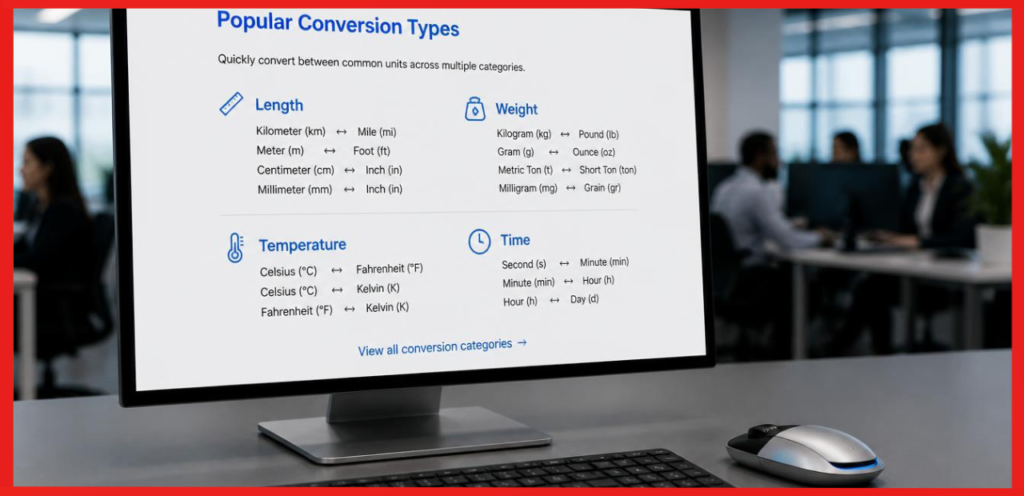
Users frequently search for these conversions:
- Convert watts to kilowatts
- Convert horsepower to kilowatts
- Convert megawatts to kilowatts
- Convert kW to amps
- Convert kW to kVA
- Convert kW to VA
- Kilowatt to watt converter
- Kilowatt to horsepower converter
- Kilowatt to BTU per hour converter
- Kilowatt to kilocalories per hour converter
- Kilowatt to megawatt converter
- Kilowatt to microwatt converter
- Kilowatt to milliwatt converter
- Kilowatt to kilowatt-hour converter
Modern Power converters perform all these calculations almost instantly.
Why SI Standards Matter
The world relies on standardized measurements.
Organizations such as the National Institute of Standards and Technology (NIST) support internationally recognized measurement practices that align with modern SI standards and Unit conversion standards.
Because everyone references the same definitions, engineers in different countries can interpret Power ratings, equipment specifications, and technical drawings consistently.That shared language quietly keeps industries moving, even though hardly anyone notices it.
Tips for Accurate Electrical Unit Conversion
Small habits improve accuracy tremendously.
- Double-check the original unit.
- Verify decimal placement.
- Use trusted Online conversion calculator tools.
- Remember that Power and energy are different.
- Use updated Conversion equations.
- Confirm voltage before calculating amps.
- Keep a reliable Power unit chart nearby.
Those little checks only take a minute, but they often prevent hours of troubleshooting later.
Choosing the Best Power Converter

Not every calculator offers the same capabilities.
A reliable Unit conversion calculator should include:
- Multiple Electrical power units
- Fast calculations
- Accurate Conversion factors
- Comprehensive Conversion reference
- Mobile compatibility
- Engineering-grade precision
- Clear Power unit equivalence
- Updated Scientific unit conversion standards
The simpler the interface, the easier it becomes to focus on solving problems instead of figuring out the calculator itself.
Frequently Asked Questions
What is a kilowatt?
A Kilowatt is an SI derived unit equal to 1,000 watts, commonly used for measuring Electrical power.
How to convert kilowatts?
Multiply or divide by the appropriate Conversion factor, or use a trusted Kilowatt Conversion Calculator for immediate results.
Is a kilowatt the same as a kilowatt-hour?
No.
A kilowatt measures Power, while a Kilowatt-hour (kWh) measures Energy consumption over time.
Why do engineers use kilowatts?
Because they provide a practical unit for describing medium and large electrical systems without extremely large numbers.
Are horsepower and kilowatts interchangeable?
Yes, through proper Power conversion, although the numerical values differ.
Frequently Asked Question
kw to unit
kW to unit converts electrical power into electricity units (kWh). One unit of electricity equals 1 kilowatt-hour (kWh), so the result depends on how long the appliance runs.
kw to unit converter
A kW to unit converter helps calculate electricity consumption by converting power (kW) and usage time into units (kWh). Simply enter the power rating and the number of hours used.
2kw in units
A 2 kW appliance uses 2 units (2 kWh) of electricity if it runs for 1 hour. Running it for 5 hours would consume 10 units (10 kWh).
kw into unit
To convert kW into units, multiply the power in kilowatts by the number of hours used. For example, 1.5 kW × 4 hours = 6 units (6 kWh).
1kw to unit
A 1 kW appliance consumes 1 unit (1 kWh) of electricity when used for 1 hour. If it runs for 3 hours, it uses 3 units (3 kWh).
Read this blog https://wittechyo.com/what-date-is-3-months-from-today/
Final Thoughts
Electricity has a reputation for sounding complicated, yet much of that mystery fades once you understand the language of measurements.
A Kilowatt Conversion Calculator isn’t just another online tool it becomes a dependable companion for students, engineers, electricians, homeowners, and curious minds alike.
Whether you’re exploring Metric power conversion, comparing Equivalent power values, performing Engineering unit conversion, or checking Electrical measurement units, having accurate conversions makes every calculation feel less like a puzzle and more like a conversation.
Keep a trustworthy Electrical power calculator close whenever you’re working with Energy and power conversions. Learn the core relationships between Kilowatt, Watt, Megawatt,
Horsepower, and Kilowatt-hours, and you’ll discover that numbers stop looking intimidating. They start telling a story instead.
Maybe not loudly, maybe not dramatically, but certainly in a way that makes a little more sense every single time you press the convert button.