

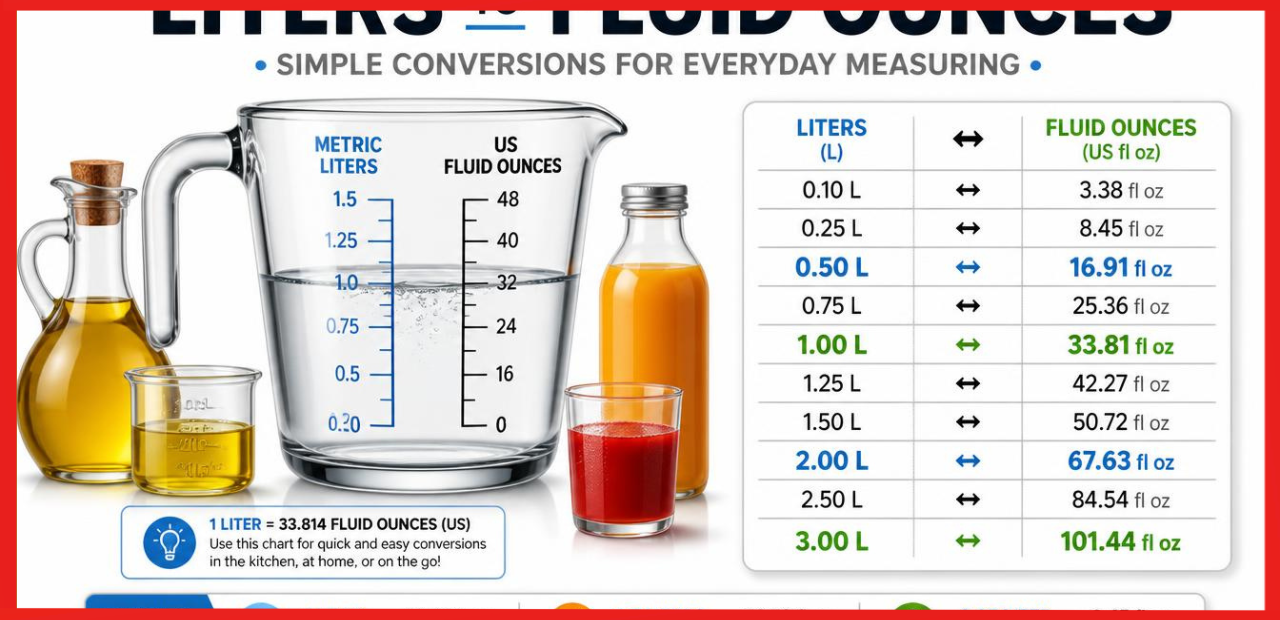
There are these oddly satisfying little moments in life when a measurement suddenly makes sense. I still remember standing in a kitchen while following a recipe from another country.
It asked for 2 Liters, but every measuring cup I owned was marked in Fluid Ounces. For a few seconds I stared at the bottle as if it owed me an explanation.
Funny thing is, once you understand the conversion, it becomes one of those tiny skills that quietly follows you everywhere into cooking, baking, science experiments, travel, nutrition labels, and even buying drinks.
Learning how to convert liters to fluid ounces isn’t difficult. It only seems mysterious because the Metric System and US Customary Units grew up speaking different mathematical languages.
Yet once they shake hands, everything feels surprisingly neat. Well… mostly neat. Numbers do enjoy making tiny messes every now and then.
This guide explains everything you need to know about Volume Conversion, from the basic formula to real-life examples, practical tables, and common mistakes people kinda make without even noticing.
| Liters | Fluid Ounces |
|---|---|
| 1 L | 33.814 fl oz |
| 2 L | 67.628 fl oz |
| 3 L | 101.442 fl oz |
| 4 L | 135.256 fl oz |
| 5 L | 169.070 fl oz |
| 10 L | 338.14 fl oz |
Understanding Liters and Fluid Ounces
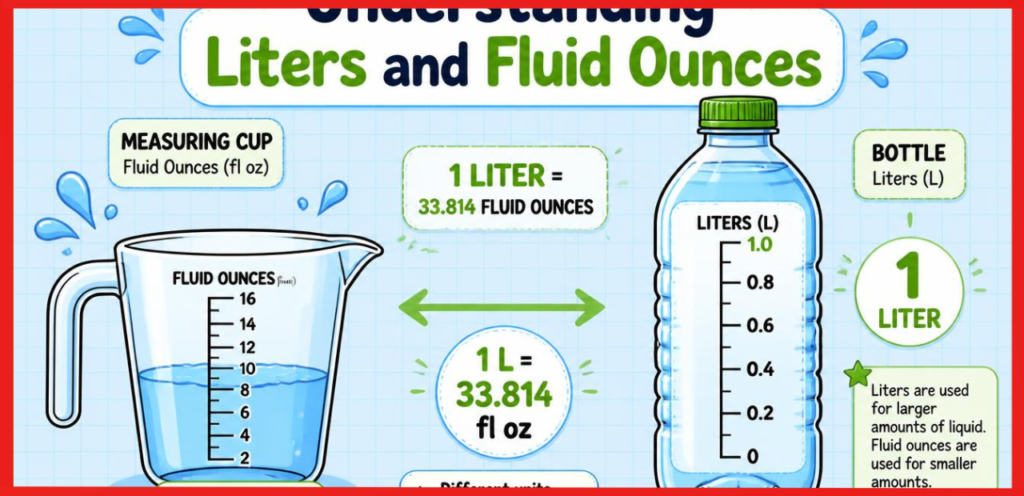
Before jumping into calculations, it helps to understand what each unit actually measures.
A Liter (L), sometimes written as Litre, belongs to the Metric System and is one of the internationally accepted SI Units for measuring Volume. It is widely used throughout Europe, Asia, Australia, and many other regions.
One liter is equal to:
- 1 Liter = 1,000 Cubic Centimeters (cm³)
- 1 Liter = 1 Cubic Decimeter (dm³)
- 1 Liter = 0.001 Cubic Meters
- 1 Liter = 0.264172 US Gallons
On the other hand, the Fluid Ounce (fl oz) belongs to the US Customary Units and is commonly used in the United States for beverages, recipes, medicine, and other Household Measurements.
Don’t confuse Fluid Ounces with regular Ounces used for weight. One measures liquid Volume Measurement, while the other measures mass. They sound alike, but they aren’t twins. More like distant cousins who only meet at family reunions.
How to Convert Liters to Fluid Ounces
The simplest way to perform Liter to Fluid Ounce Conversion is by using a single multiplication.
Liters to Fluid Ounces Formula
The standard Conversion Formula is:
Fluid Ounces = Liters × 33.814023
This number represents the official Conversion Ratio:
1 L = 33.814023 fluid ounces per liter
So whenever you want to convert liters to fluid ounces, simply multiply the number of liters by 33.814023.
This Volume Conversion Formula works for every liquid, whether you’re measuring water, milk, juice, cooking oil, or something much less exciting like laboratory chemicals.
Why Is 1 Liter Equal to 33.814 Fluid Ounces?
Many people wonder why the number isn’t something clean like 30 or 35.
The reason comes from the relationship between Metric Units and US Volume Unit definitions.
A US Fluid Ounce equals approximately 29.5735 Milliliters (mL).
Since:
1 Liter = 1,000 Milliliters (mL)
Then:
1000 ÷ 29.5735 ≈ 33.814023
That’s where the famous conversion comes from.
Interestingly, for Nutrition Labeling, manufacturers often round things slightly and use:
1 Fluid Ounce = 30 Milliliters
This makes nutrition facts easier to read, although scientific calculations still use the exact value.
Examples of Liters to Fluid Ounces Conversion
Nothing makes a formula feel friendly quite like examples.
Example 1
Convert 1 Liter.
1 × 33.814023 = 33.814 fl oz
Example 2
Convert 2 Liters.
2 × 33.814023 = 67.628 fl oz
Example 3
Convert 3 Liters.
3 × 33.814023 = 101.442 fl oz
Example 4
Convert 5 Liters.
5 × 33.814023 = 169.070 fl oz
After solving a few problems, you’ll probably notice your brain starts estimating conversions before the calculator even wakes up.
Liters to Fluid Ounces Conversion Table
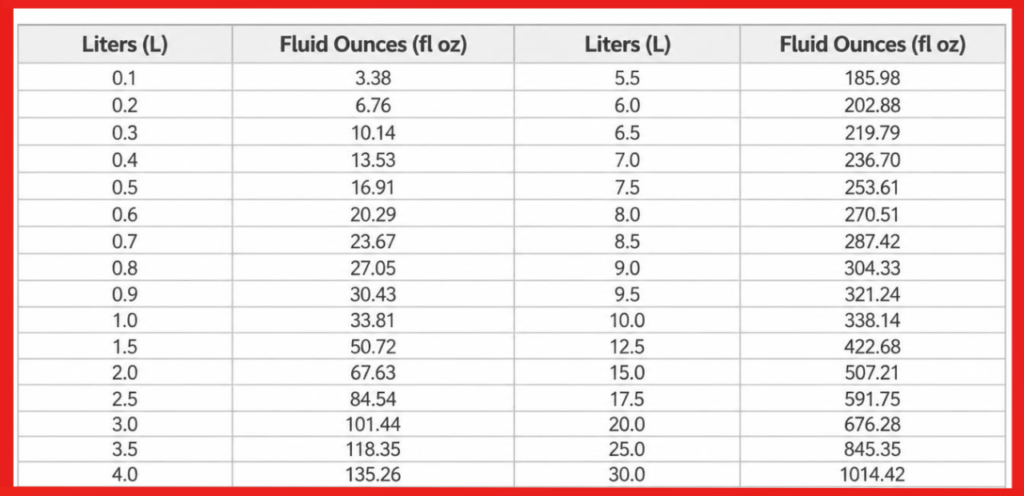
A quick Conversion Table is often faster than using a calculator.
| Liters | Fluid Ounces |
|---|---|
| 1 L | 33.814 fl oz |
| 2 L | 67.628 fl oz |
| 3 L | 101.442 fl oz |
| 4 L | 135.256 fl oz |
| 5 L | 169.070 fl oz |
| 10 L | 338.14 fl oz |
| 20 L | 676.28 fl oz |
| 30 L | 1,014 fl oz |
| 40 L | 1,353 fl oz |
This liters to ounces conversion table becomes handy in kitchens, laboratories, beverage production, and manufacturing.
Using a Conversion Calculator
Although mental math works for simple values, many people prefer using a Conversion Calculator or Unit Conversion Calculator.
A good Volume Calculator instantly performs:
- convert liters to ounces
- convert liters to fluid ounces
- convert liquid volume units
- metric conversion
- liquid measurement conversion
Modern measurement calculator tools eliminate rounding mistakes and save time when handling larger numbers.
If you’re working with recipes every day, a liquid volume calculator honestly becomes one of those bookmarks you keep forever.
Liters Compared With Other Volume Units
Knowing how liters relate to other volume units makes conversions much easier.
| Unit | Equivalent |
| Milliliters (mL) | 1,000 mL |
| US Gallons | 0.264172 |
| Quarts | 1.057 |
| Pints | 2.113 |
| Cups | 4.227 |
| Tablespoons | 67.628 |
| Teaspoons | 202.884 |
| Cubic Inches | 61.024 |
| Cubic Feet | 0.0353 |
| Cubic Yards | 0.001308 |
These Volume Equivalents explain why recipes from different countries sometimes appear completely different even though they’re describing exactly the same amount of liquid.
Common Liters to Fluid Ounces Questions
How many fluid ounces are in a liter?
There are exactly 33.814023 US Fluid Ounces in one liter.
How many ounces in 1 liter?
Approximately 33.814 fl oz.
How many ounces in 2 liters?
Approximately 67.628 fl oz.
How many ounces in 3 liters?
Approximately 101.442 fl oz.
How many ounces in 5 liters?
Approximately 169.070 fl oz.
These values answer many of the most searched questions online regarding fluid ounces per liter.
Real-Life Uses for Liter to Fluid Ounce Conversion
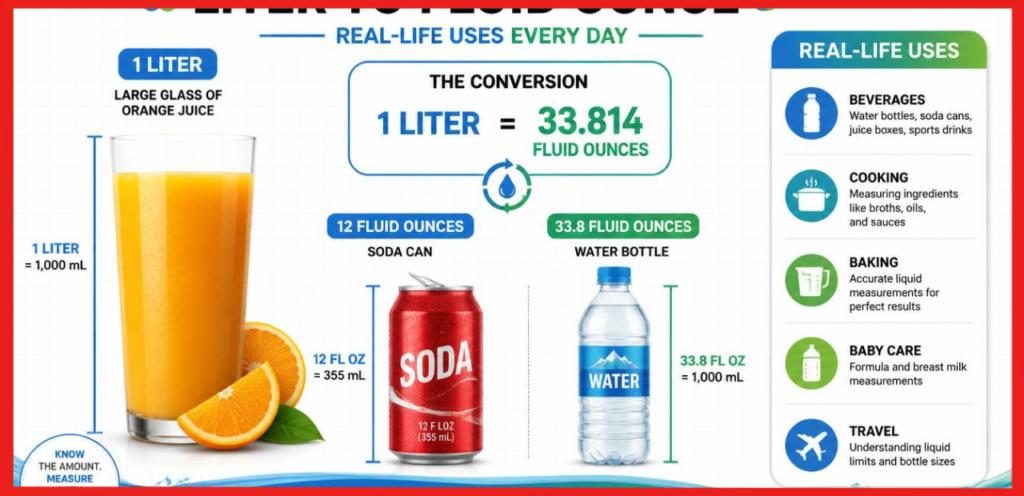
People sometimes assume this conversion belongs only in math class. It really doesn’t.
Cooking and Baking
International recipes often switch between Metric Measurements and US Customary Measurements.
Knowing liters to fluid ounces helps avoid ruining a soup or accidentally making enough pancake batter for an entire neighborhood.
Nutrition Labeling
Many drink bottles display both Milliliters (mL) and US Fluid Ounce values.
Understanding the relationship makes comparing products much easier.
Science Measurements
Laboratories frequently use Metric Volume Unit standards while reports may also require US Volume Unit equivalents.
Accurate Measurement Conversion matters here far more than guessing.
Travel
Buying bottled water overseas can feel slightly confusing until you realize that a one-liter bottle contains roughly 34 fluid ounces.
Suddenly everything feels familiar again.
Common Mistakes When Converting Liters to Fluid Ounces
Even simple math attracts mistakes like cookies attract crumbs.
Some common ones include:
- Confusing weight Ounces with Fluid Ounces
- Forgetting to multiply by 33.814023
- Using Imperial Fluid Ounces instead of US Fluid Ounce
- Rounding too early
- Mixing Imperial Units with US Customary Units
Taking an extra second to check your unit labels usually saves a surprising amount of confusion.
Related Volume Conversions Worth Knowing
Once you’ve learned L to fl oz, many other conversions become much easier.
You may also need:
- liters to gallons
- liters to quarts
- liters to pints
- liters to cups
- liters to tablespoons
- liters to teaspoons
- liters to cubic inches
- liters to cubic feet
- liters to cubic yards
- liters to milliliters
- liters to cubic centimeters
- liters to cubic meters
- milliliters to fluid ounces
- gallons to fluid ounces
- quarts to fluid ounces
- cups to fluid ounces
These relationships create a complete fluid measurement guide that works in nearly every situation involving liquids.
Quick Tricks to Estimate Fluid Ounces
Sometimes exact numbers aren’t necessary.
Here are a few practical shortcuts.
- 1 liter is roughly 34 fluid ounces.
- Half a liter is about 17 fluid ounces.
- Two liters equal roughly 68 fluid ounces.
- Five liters are close to 170 fluid ounces.
These estimates are perfectly useful for everyday cooking, shopping, or filling reusable water bottles.
Why the Metric System Makes Volume Conversion Easier
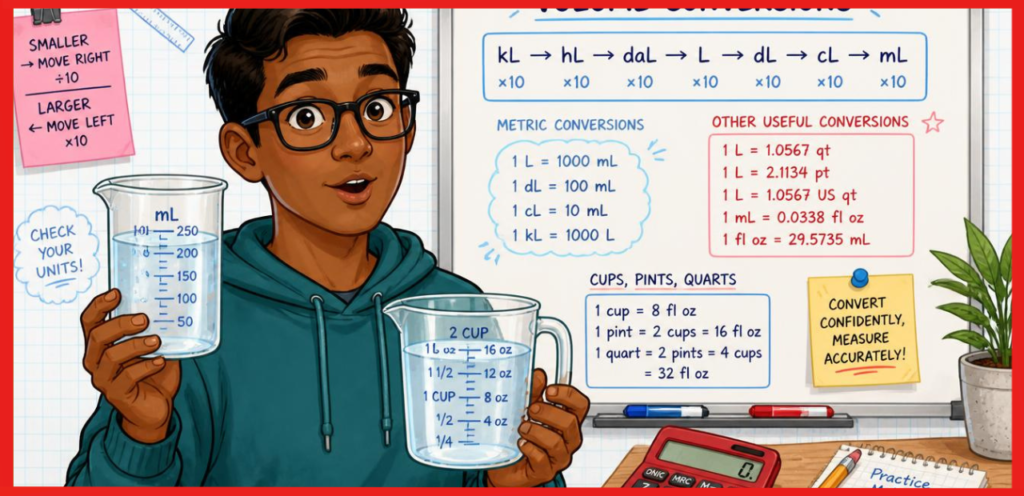
There’s something oddly comforting about the Metric System.
Everything scales by powers of ten.
One Liter becomes:
- 1,000 Milliliters
- 100 centiliters
- 10 deciliters
That consistency is why scientists around the world prefer SI Accepted Unit standards.
By comparison, US Customary Units involve Cups, Pints, Quarts, and Gallons, each with different relationships. They work perfectly well, but they definitely enjoy keeping people on their toes.
Frequently Asked Question
5 liter to oz
5 liters to oz equals approximately 169.07 fluid ounces. Simply multiply 5 by 33.814 to convert liters into US fluid ounces.
5l to oz
5L to oz is 169.07 US fluid ounces. This conversion is useful for recipes, beverage containers, and liquid measurements.
3l to oz
3L to oz equals about 101.44 fluid ounces. Multiply 3 liters by 33.814 to get the exact result.
3l to fl oz
3L to fl oz converts to approximately 101.44 US fl oz. It’s a quick way to switch between metric and US customary volume units.
3.5 liters to oz
3.5 liters to oz equals approximately 118.35 fluid ounces. Multiply 3.5 by 33.814 to calculate the conversion accurately.
Read this blog https://wittechyo.com/32-weeks-from-today/
Final Thoughts on Converting Liters to Fluid Ounces
Learning how to convert liters to fluid ounces isn’t about memorizing a random number. It’s about understanding how two different measurement systems describe exactly the same liquid in different languages.
Remember the essential equation:
Fluid Ounces = Liters × 33.814023
Once that becomes familiar, every bottle, recipe, nutrition label, laboratory report, or travel guide suddenly feels much less intimidating.
Whether you’re using a liter to ounce converter, a volume conversion chart, a conversion calculator, or simply doing quick mental arithmetic, the process remains exactly the same. With a little practice, you’ll find yourself converting liters into ounces almost without thinking about it.
Measurements have a quiet way of connecting people across countries and cultures. One kitchen measures in liters, another reaches for fluid ounces, yet both end up sharing the same meal. Somehow, that’s a rather lovely kind of mathematics.