


There’s a funny little moment that happens before almost every outdoor project. You stand there, maybe holding a tape measure that somehow feels too small for the job, staring at a patch of ground.
You wonder, How much mulch do I actually need? Or maybe it’s gravel, soil, concrete, or plain old dirt.
Someone throws around the phrase “Cubic Yard Calculator” and suddenly everyone nods as if cubic yards have been their lifelong friends. I used to nod too, if I’m honest, while secretly hoping nobody would ask me to explain it.
Turns out, it isn’t difficult. It’s just hidden beneath words that sound bigger than they really are. Once you understand how Volume, Measurement, and Dimensions work together, everything clicks into place.
Well… almost everything. Sometimes you’ll still measure twice because the first measurement looked suspiciously optimistic, and that’s alright.
Whether you’re planning a Construction Project, refreshing a backyard, filling raised garden beds, or simply trying to avoid ordering way too much material, this guide will walk you through every important concept.
No confusing math lectures. Just practical explanations, real-world examples, and a few unexpected observations that somehow make measuring dirt feel oddly interesting.
| Step | Formula / Action | Example |
|---|---|---|
| Measure dimensions | Length × Width × Depth (all in feet) | 12 ft × 10 ft × 0.5 ft |
| Calculate cubic feet | Length × Width × Depth | 12 × 10 × 0.5 = 60 ft³ |
| Convert to cubic yards | Cubic Feet ÷ 27 | 60 ÷ 27 = 2.22 yd³ |
| Final Answer | Round up if |
What Is a Cubic Yard Calculator?
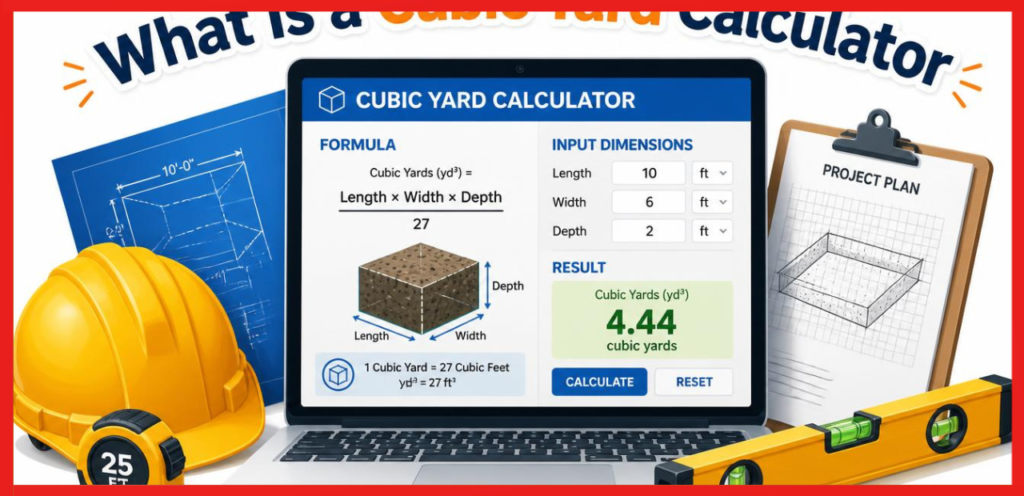
A Cubic Yard Calculator is a tool that estimates how much three-dimensional space something occupies. Instead of measuring only length or area, it measures Volume the amount of space inside an object or area.
Think about a box.
If you know its Length, Width, and Height, you can calculate exactly how much space it contains. A calculator simply performs that Volume Calculation for you and converts the answer into Cubic Yards, which is the standard unit used by many construction suppliers.
A Cubic Yard (cu yd, yd³) equals a cube measuring:
- 1 Yard (yd) long
- 1 yard wide
- 1 yard high
Since one yard equals three feet:
- 1 cubic yard = 27 Cubic Feet (cu ft)
That’s probably the number you’ll remember forever after today.
Why Cubic Yards Matter More Than You Think
Most people buy landscaping material only a handful of times. Because of that, they often estimate by eye.
Eyes are… optimistic creatures.
You glance at a flower bed and think it looks tiny. Twenty bags later, you’re still not finished. Been there.
Using Cubic Yardage instead of guessing saves money, reduces trips to the supplier, and prevents piles of leftover material from decorating your driveway for three weeks longer than intended.
Professionals rely on cubic yard calculations for:
- Concrete
- Gravel
- Soil
- Mulch
- Fill Dirt
- Aggregate
- Compost
- Sand
- Decorative rock
- Excavation projects
Whether you’re building a patio or creating a new Flower Bed, accurate Material Estimation makes the project much smoother.
Cubic Yard Calculator Formula Explained
The heart of every Cubic Yard Calculator is surprisingly simple.
Start by measuring:
- Length
- Width
- Depth or Height
Then calculate the total Volume.
Rectangular Formula
For a Rectangle, Cuboid, or Rectangular Prism, the formula is:
Length × Width × Height = Cubic Feet
Then convert to cubic yards.
Divide by 27
That’s it.
This is why you’ll constantly hear contractors say:
“Don’t forget to divide by twenty-seven.”
It becomes second nature after a while, though I still sometimes reach for the calculator just to double-check.
Example
Suppose your garden bed measures:
- Length = 18 ft
- Width = 6 ft
- Depth = 0.5 ft
Volume:
18 × 6 × 0.5 = 54 cubic feet
Now convert:
54 ÷ 27 = 2 Cubic Yards
So you’d order approximately 2 cubic yards of mulch.
How to Calculate Cubic Yards Step by Step
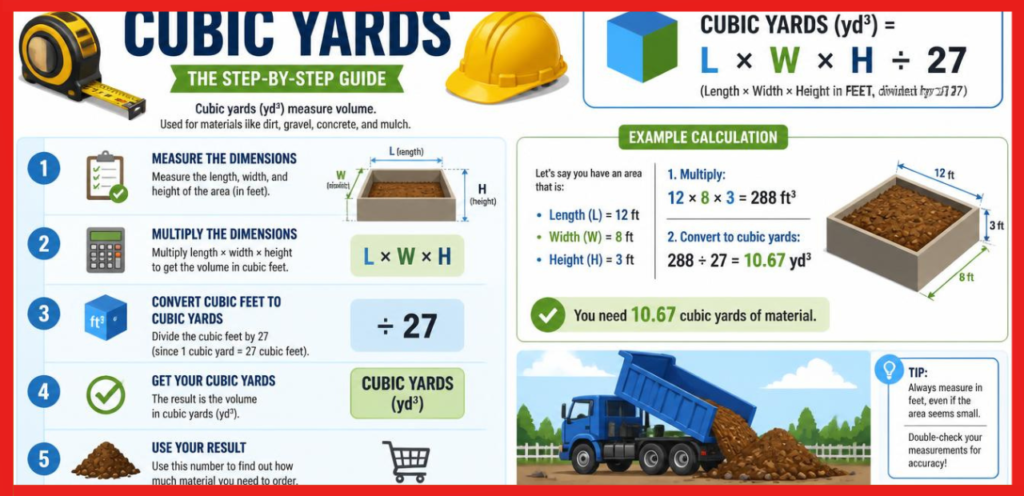
Learning how to calculate cubic yards isn’t difficult once the process becomes routine.
Step One: Measure Length
Always Measure Length from one end to the other.
Step Two: Measure Width
Next, Measure Width across the space.
Step Three: Measure Height or Depth
Depending on the project, you’ll either Measure Height or Measure Depth.
For landscaping, depth is usually measured in inches first.
Step Four: Convert Inches to Feet
Need to Convert Inches to Feet?
Simply divide inches by 12.
Examples:
- 6 inches = 0.5 ft
- 4 inches = 0.33 ft
- 9 inches = 0.75 ft
Step Five: Calculate Volume
Multiply:
Length × Width × Height
Step Six: Divide by 27
Finally:
Cubic Feet to Cubic Yards
Volume in cubic feet ÷ 27 = cubic yards.
Simple. Almost suspiciously simple.
Using a Cubic Yard Calculator for Landscaping
One of the most common uses for a landscaping cubic yard calculator is estimating landscape materials.
Projects include:
- Mulch
- Decorative stone
- Soil
- Compost
- Playground chips
- Bark
- Gravel
Imagine adding mulch around trees.
You measure carefully, order the correct amount, and everything fits beautifully.
Or…you eyeball it, order half as much, then drive back to the supplier while wondering why math exists.
A calculator usually wins.
Cubic Yard Calculator for Concrete
Pouring Concrete leaves very little room for mistakes.
Too little?
The truck leaves.
Too much?
You’ve paid for concrete you’ll never use.
That’s why builders use a dedicated concrete calculator before ordering.
Typical projects include:
- Sidewalks
- Driveways
- Garage floors
- Patios
- Footings
Always measure carefully because wet concrete doesn’t politely wait while you rethink the numbers.
Cubic Yard Calculator for Gravel
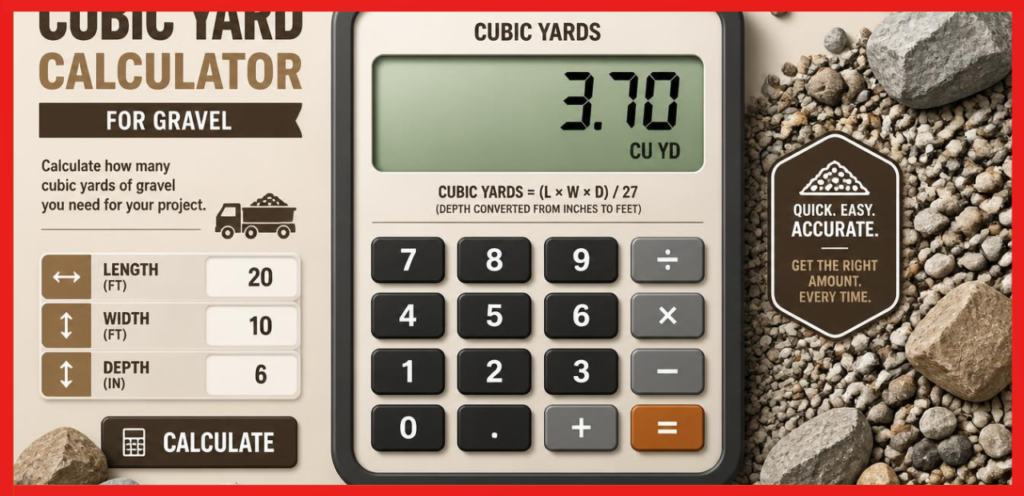
Gravel appears simple until you discover there are several different depths depending on usage.
Driveways often require:
- 4–6 inches
Walkways:
- 2–3 inches
Drainage areas:
- Sometimes much deeper.
Using a gravel calculator ensures you order enough Aggregate without massively overspending.
Cubic Yard Calculator for Mulch
Fresh mulch changes an entire yard.
It’s almost unfair how much nicer everything suddenly looks.
A mulch calculator estimates exactly how many cubic yards you’ll need depending on:
- Area
- Desired depth
- Material type
Many homeowners spread mulch around:
- Trees
- Shrubs
- Garden beds
- Pathways
Cubic Yard Calculator for Soil
A soil calculator helps estimate garden soil for:
- Raised beds
- Lawn leveling
- Vegetable gardens
- New landscaping
Since soil settles slightly over time, many gardeners add a little extra.
Not mountains of extra.
Just enough.
Cubic Yard Calculator for Dirt
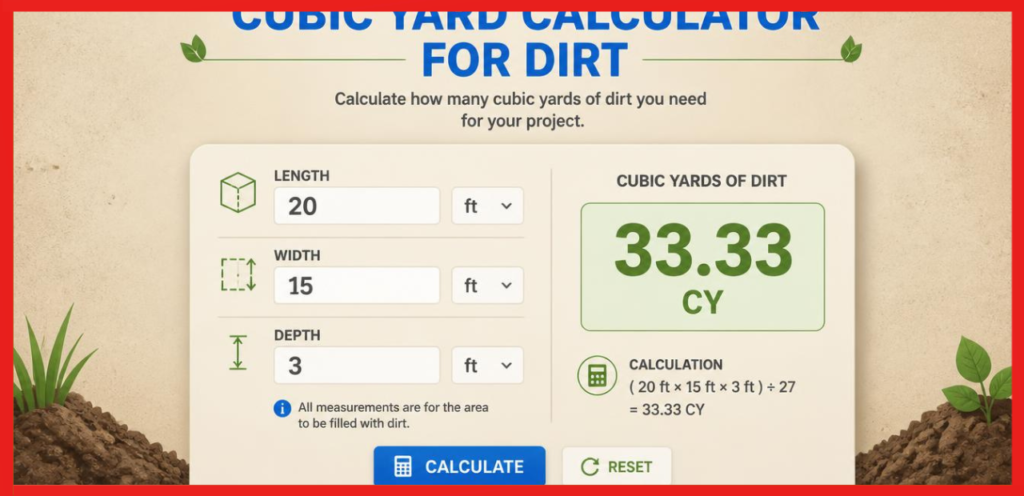
Need Fill Dirt?
Whether you’re leveling a yard or filling low spots, estimating correctly prevents expensive repeat deliveries.
This is where a material calculator becomes incredibly useful.
Cubic Yard Calculator for Flower Beds
A new flower bed usually looks smaller during planning than it does while digging.
To calculate cubic yards for a flower bed, simply measure:
- Length
- Width
- Desired soil depth
Then perform the standard Volume Formula.
Nothing fancy required.
Unit Conversion Made Easy
Many people measure differently.
Some use:
- Feet
Others:
- Inches
Some even measure in Meter (m) or Centimeter (cm).
Fortunately, Unit Conversion makes everything compatible.
Useful conversions include:
- Convert Feet to Yards
- Convert Cubic Feet to Cubic Yards
- Convert Inches to Feet
- Measurement Conversion
- Volume Conversion
Having a reliable Unit Converter nearby saves lots of calculator tapping.
Cubic Yard Formula for Different Shapes
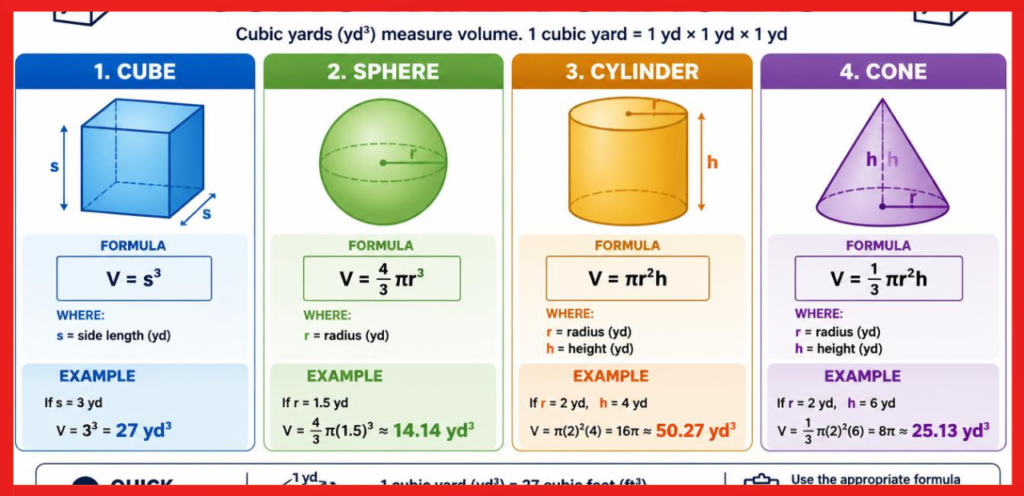
Not every project is rectangular.
Sometimes nature refuses to cooperate.
Cube
A Cube has equal sides.
Volume:
Side × Side × Side
Cuboid
The Cuboid uses:
Length × Width × Height
Cylinder Formula
Need the Cylinder Formula?
Use:
π × Radius² × Height
Remember:
- π (Pi) ≈ 3.14159
If you know the Diameter, divide by two first to find the radius.
This formula works for:
- Round planters
- Wells
- Circular columns
Complex Shape
For a Complex Shape, divide it into smaller Geometric Shapes, calculate each separately, then combine the totals.
It’s easier than wrestling one enormous equation.
Understanding Cubic Measurement
A Cubic Measurement always represents three dimensions.
Not one.
Not two.
Three.
Imagine stacking invisible cubes until the entire space is filled.
That’s essentially what volume measures.
This idea helps explain why Area alone isn’t enough.
Area tells you how much surface exists.
Volume tells you how much material fills that surface.
Real-World Example: Toyota Tacoma Truck Bed
Suppose you’re using a 2022 Toyota Tacoma with a Toyota Tacoma 6-foot Truck Bed.
Many people wonder:
Can one load carry a full cubic yard?
Usually, truck bed capacity depends on:
- Payload
- Bed dimensions
- Material weight
A cubic yard of mulch may fit comfortably.
A cubic yard of wet gravel?
That’s another story entirely.
Always check your vehicle’s payload rating before loading heavy materials.
Material Cost Estimation

Knowing the required volume helps estimate the final bill.
Multiply:
Required cubic yards × Price Per Yard
Remember to include:
- Delivery charges
- Taxes
- Minimum order quantities
Some suppliers also charge for a Partial Yard.
Others sell only whole-yard increments.
Always ask beforehand.
Should You Round Up?
Almost always.
Here’s why.
Materials settle.
Some spill.
Mistakes happen.
Most professionals slightly Round Up when ordering.
It’s usually cheaper than placing a second delivery order.
Cubic Yard to Ton Conversion
Loose materials often sell by volume but transport by weight.
Examples include:
- Gravel
- Stone
- Aggregate
A yard to ton calculator estimates:
Convert Cubic Yards to Tons
Unfortunately there isn’t one universal Conversion Factor.
Different materials weigh differently.
Dry mulch and wet gravel certainly don’t behave the same. Not even close.
Always ask your supplier for the recommended conversion.
Common Mistakes People Make

Even experienced DIY enthusiasts occasionally miscalculate.
Frequent errors include:
- Forgetting to Convert Inches to Feet
- Using outside instead of inside measurements
- Ignoring slopes
- Forgetting to Divide by 27
- Ordering exact amounts without accounting for Material Waste
- Confusing Square Yard with cubic yard
- Mixing metric and imperial units
Tiny mistakes become expensive surprisingly fast.
Cubic Yard Coverage Guide
Coverage depends entirely on depth.
One cubic yard covers:
- About 324 square feet at 1 inch deep
- Around 162 square feet at 2 inches
- Roughly 108 square feet at 3 inches
- Approximately 81 square feet at 4 inches
The deeper the layer, the smaller the coverage area becomes.
Seems obvious now, though it catches plenty of people off guard.
Helpful Tips Before Ordering Materials
Before calling your Landscape Supplier or Concrete Supplier, remember to:
- Double-check every measurement.
- Confirm your Dimensions.
- Verify the desired depth.
- Estimate a little extra.
- Compare supplier pricing.
- Ask about delivery limits.
- Confirm whether materials are sold by volume or weight.
- Check truck access to your property.
Five extra minutes measuring can save hours of frustration later.
Frequently Asked Questions
How many cubic feet are in a cubic yard?
There are exactly 27 Cubic Feet in one Cubic Yard.
Can I calculate cubic yards using inches?
Yes. First convert inches into feet, then perform the calculation.
What’s the easiest way to estimate materials?
Measure accurately, calculate Volume, convert to cubic yards, then slightly round upward.
Do online calculators replace measuring?
No.
A cubic yard calculator online only works if your measurements are accurate in the first place.
Garbage in…well, you know the rest.
Frequently Asked Question
CY Calculator
A CY calculator helps you quickly estimate the number of cubic yards needed for construction or landscaping projects. Simply enter the dimensions to calculate material volume accurately.
CU YD Calculator
A CU YD calculator converts your measurements into cubic yards, making it easy to estimate concrete, gravel, mulch, or soil requirements. It reduces guesswork and helps avoid ordering too much or too little material.
IRT Volume Calculator
An IRT volume calculator is designed to estimate the volume of a space using its dimensions. It provides quick results for planning material quantities in various residential and commercial projects.
Yardage Calc
A yardage calc is a simple way to determine the amount of material needed in cubic yards. It is commonly used for landscaping, excavation, and construction planning.
CU Yard Calculator
A CU yard calculator measures the volume of a space in cubic yards based on its length, width, and depth. It helps you estimate the right amount of fill dirt, concrete, gravel, or mulch for your project.
Read this blog https://wittechyo.com/what-is-10-weeks-from-today/
Final Thoughts
Learning how to use a Cubic Yard Calculator isn’t really about becoming brilliant at mathematics. It’s about making better decisions before money leaves your wallet and trucks arrive at your driveway.
Whether you’re estimating Concrete, Mulch, Gravel, Soil, or Fill Dirt, understanding Volume Calculation, Measurement Conversion, and simple geometric formulas gives you confidence that guessing never could.
The numbers may look intimidating at first, but after calculating one or two projects, they’ll begin to feel almost familiar. Funny how that happens.
The next time someone asks how much material a project needs, you won’t have to shrug and hope for the best.
You’ll know how to Calculate Volume, convert Cubic Feet to Cubic Yards, estimate Material Cost, and even decide when it’s smart to Round Up for unavoidable Material Waste.
And if you’ve discovered a clever measuring trick, found an easier way to estimate Landscaping Materials, or have a memorable story about ordering either way too much or painfully too little share it with others.
Those real experiences often teach more than any formula ever could, even if the formulas are still doing most of the heavy lifting.