
There is something quietly magical about looking at a clock with moving hands instead of glowing numbers. Maybe it’s because a bold Analog clock never rushes you.
It simply points, circles, and whispers the passing of Time in its own old-fashioned language. I still remember sitting beside my grandfather as a kid, staring at the kitchen wall clock.
He smiled, tapped the glass gently, and said, “The clock isn’t hiding the answer, you’re just not asking it the right way.”
Funny enough, I didn’t get what he meant for years, but when I finally learned to Read an analog clock, that sentence kinda made perfect sense.
Today, many people rely on a Digital clock on their phones, watches, or laptops. Numbers appear instantly, leaving no mystery at all.
Yet schools, exams, workplaces, and everyday life still use traditional clocks. Knowing how to read an analog clock isn’t just a childhood skill anymore it’s part observation, part pattern recognition, and oddly enough, a little bit of patience.
Whether you’re helping a child, refreshing your own memory, or simply curious about Understanding analog clocks, this guide walks through every step in a simple and practical way.
| Clock Part | What It Does | Example |
|---|---|---|
| Hour Hand | Shows the hour and is the shortest hand | Points near 3 = around 3 o’clock |
| Minute Hand | Shows the minutes and is the longest hand | Points at 6 = 30 minutes |
| Second Hand | Counts seconds (if present) | One full rotation = 60 seconds |
| Read the Time | Read the hour hand first, then the minute hand | Hour at 3, minute at 6 = 3:30 |
Why Learning How to Read an Analog Clock Still Matters
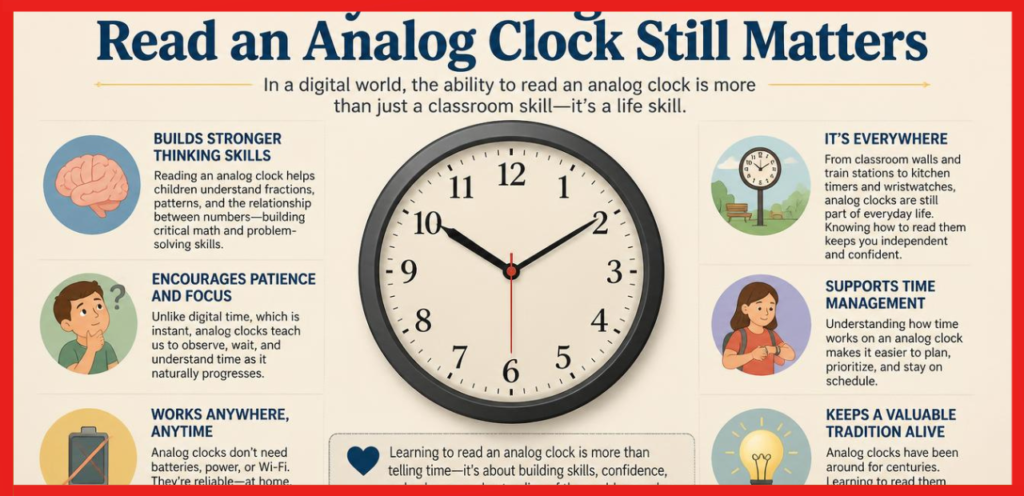
Some people wonder if learning traditional clocks is still worth the effort. Honestly, it is. A phone battery dies. A classroom wall clock doesn’t care if your charger is missing.
Learning How to read an analog clock improves visual thinking and strengthens Time measurement skills.
It also helps children understand fractions, counting, sequencing, and estimation. It’s a tiny lesson that somehow stretches into several other subjects without making a fuss about it.
An analog clock also teaches movement instead of static numbers. Instead of reading digits, you observe Clock movement, Clock rotation, and the changing relationship between the Clock hands.
What Is an Analog Clock?
An Analog clock is a traditional clock that tells Time using moving hands on a Circular clock face rather than displaying numbers digitally.
Unlike a Digital clock, which shows something like 3:20, an analog clock represents that same moment through the position of its hands.
The basic purpose remains exactly the same.
- Show the current time.
- Measure passing time.
- Help with scheduling.
- Support everyday Timekeeping.
Once you understand the moving parts, reading it becomes surprisingly natural.
Parts of an Analog Clock
Before learning How to read an analog clock step by step, it’s important to recognize every major part.
The Clock Face
The Clock face is the round surface containing the Clock face numbers from 1 through 12. This is often called the Numbered clock face or Clock dial.
Around the outside are Tick marks.
These markings represent individual minutes and seconds.
The Hour Hand
The Hour hand is the shortest hand.
Sometimes beginners expect it to point exactly at a number all the time, but it actually moves slowly between numbers as the hour progresses. That’s why it gives clues about the Current hour.
This hand is sometimes referred to as the Hour indicator.
The Minute Hand
The Minute hand is longer.
It points to the minute value using the Large tick marks and Small tick marks around the clock.
It is also known as the Minute indicator.
The Second Hand
Many clocks include a thin Second hand.
This hand completes one full rotation every minute, measuring Seconds or 5-second intervals as it moves.
Some classroom clocks leave this hand out completely, which is perfectly normal.
How to Read an Analog Clock Step by Step
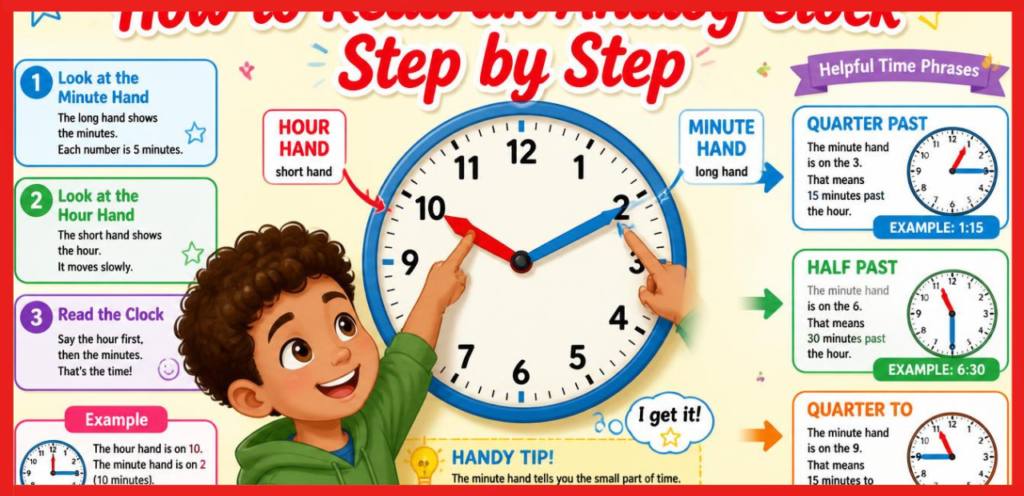
Learning How to read an analog clock becomes much easier when you always follow the same order.
Step 1: Find the Hour Hand
Always start with the Hour hand.
Ask yourself:
Which number has it passed?
If it’s between 3 and 4, then the hour is still 3.
That tells you the Current hour.
Never choose the number ahead of it unless the hand has completely reached it.
Step 2: Look at the Minute Hand
Next comes the Minute hand.
Every large number equals 5-minute intervals.
Here’s the pattern:
| Number | Minutes |
|---|---|
| 1 | 5 |
| 2 | 10 |
| 3 | 15 |
| 4 | 20 |
| 5 | 25 |
| 6 | 30 |
| 7 | 35 |
| 8 | 40 |
| 9 | 45 |
| 10 | 50 |
| 11 | 55 |
| 12 | 00 |
This counting method is simply Counting by fives, one of the easiest shortcuts in Analog time reading.
Step 3: Read the Exact Minute
If the hand isn’t exactly on a number, count the extra Small tick marks.
Each tiny mark equals one minute.
This improves your Reading minutes ability quickly after a bit of practice.
Step 4: Check the Second Hand
If your clock includes a Second hand, read it exactly the same way as minutes.
Each complete circle equals 60 seconds.
This supports accurate Reading seconds.
Understanding the Clock Face Explained
Many learners struggle because they focus only on numbers instead of positions.
Think of the Clock face as a circle divided into 60 equal pieces.
The 12 o’clock position always represents both zero minutes and sixty minutes.
The numbers around the clock represent multiples of five.
Meanwhile, every tiny mark fills the gap between those larger values.
Once this pattern clicks, the whole system feels way less confusing.
Reading Hours and Minutes Together
Let’s combine everything.
Imagine:
- Hour hand between 7 and 8.
- Minute hand pointing at 6.
The minute value is 30.
The hour remains 7.
The answer becomes:
7:30
Notice how the hour hand isn’t sitting exactly on 7 anymore. It’s halfway toward 8.
That’s completely normal and actually helps confirm your answer.
The Famous 3:20 Example
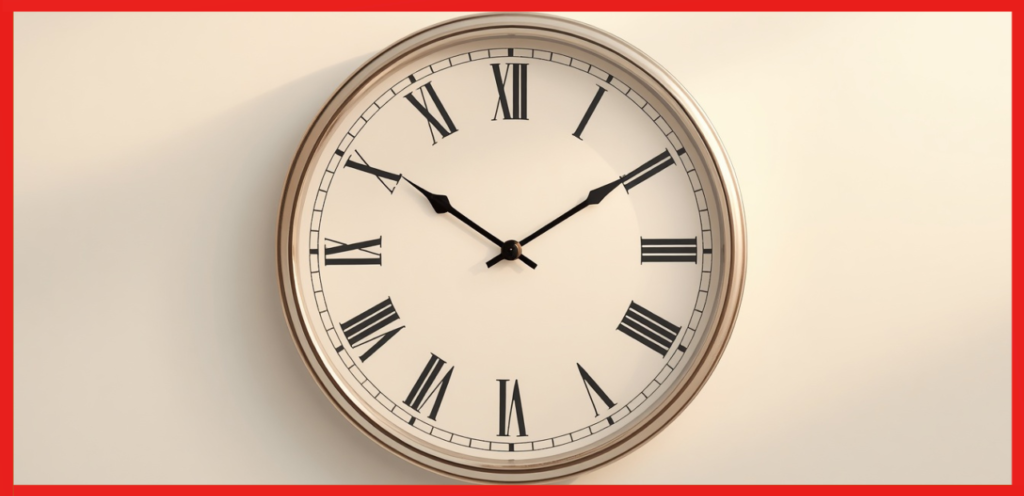
A classic classroom example is 3:20 example.
Here’s how it works.
The Hour hand sits slightly past 3.
The Minute hand points at 4.
Since:
4 × 5 = 20
The Time display becomes:
3:20
Seeing this example repeatedly helps build confidence because it demonstrates both hand positions very clearly.
Reading Seconds on an Analog Clock
Not every clock includes seconds, but many do.
The Second hand is usually:
- Thin
- Fast-moving
- Long
Each small mark equals one second.
Every numbered position equals 5-second intervals.
For example:
If the second hand points at the 8,
8 × 5 = 40
The clock shows 40 seconds.
Simple, but people often overlook it.
Analog Clock vs Digital Clock
A Digital clock gives the answer immediately.
An Analog clock asks you to interpret movement.
| Analog Clock | Digital Clock |
|---|---|
| Uses hands | Uses numbers |
| Shows movement | Shows fixed digits |
| Helps visualize time | Faster to read |
| Improves estimation | Better for precision |
Neither is better.
Both simply communicate Time differently.
Common Mistakes Beginners Make

Learning How to tell time on an analog clock becomes easier when you know what to avoid.
One common mistake is confusing the Hour hand with the Minute hand.
Another is forgetting that the hour hand keeps moving during the hour.
Some learners count minutes one by one instead of using Five-minute increments, making the process much slower.
Others ignore the Clock markings, missing those tiny minute indicators entirely.
Mistakes are honestly part of learning. Every skilled clock reader made them at some point.
Tips to Learn Clock Reading Faster
If you’re teaching children or refreshing your own skills, these habits help a lot.
- Practice reading a wall clock several times each day.
- Count around the clock using fives.
- Compare an Analog clock with a Digital clock.
- Cover the digital display and guess first.
- Draw your own clock hands.
- Practice different Clock hand positions.
- Focus on Reading hours, then Reading minutes, then seconds.
Small daily practice works better than one huge study session.
Analog Clock Reading Examples
Let’s try several quick examples.
Example One
Hour hand near 10.
Minute hand at 12.
Answer:
10:00
Example Two
Hour hand between 5 and 6.
Minute hand at 9.
Answer:
5:45
Example Three
Hour hand just after 1.
Minute hand at 2.
Answer:
1:10
Example Four
Hour hand nearly reaching 8.
Minute hand at 11.
Answer:
7:55
Examples like these improve Clock skills naturally.
How to Teach Children to Read a Clock
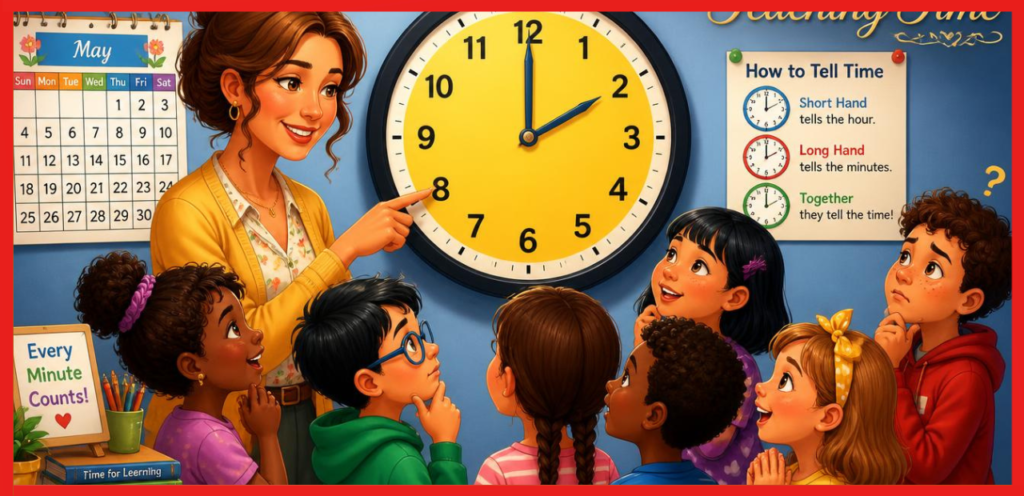
Kids often enjoy stories more than instructions.
One teacher once said,
“The little hand is never in a hurry, but the long hand loves running laps.”
That simple comparison sticks surprisingly well.
You can also use colorful paper clocks where children physically move the hands themselves.
Games work wonderfully too.
Ask questions like:
“What time do you eat breakfast?”
“What time does school begin?”
Connecting clocks with real life makes Time learning feel meaningful instead of memorized.
Using an Interactive Analog Clock
An Interactive analog clock can speed up learning because children instantly see how changing one hand affects the other.
Many educational websites allow users to drag the Clock hands, creating unlimited Analog clock examples for practice.
Interactive tools make Clock reading exercise sessions more engaging than worksheets alone.
Still, practicing with an actual wall clock remains important because real clocks don’t pause while you’re thinking.
Clock Reading Practice Exercises
Try solving these yourself.
- Hour hand between 2 and 3, minute hand at 6.
- Hour hand between 9 and 10, minute hand at 1.
- Hour hand just after 11, minute hand at 8.
- Hour hand between 4 and 5, minute hand at 10.
Don’t rush.
Think about the Hand position, count carefully, then check your answers.
Practice slowly today, and tomorrow your brain somehow starts recognizing patterns without even trying. It’s kinda strange, honestly.
Why Analog Clocks Improve Thinking
Research in education often suggests that visual learning strengthens reasoning skills.
Reading moving hands encourages estimation instead of instant recognition.
Learners begin noticing angles, distances, fractions, and rotations without realizing they’re practicing mathematics.
That’s why many teachers still include Clock education, Time lesson, and Beginner clock lesson activities in elementary classrooms.
Traditional clocks quietly teach much more than simply telling time.
Everyday Situations Where Analog Clock Skills Help
You may read a classroom wall clock.
You may glance at a train station clock.
You may notice a decorative clock inside an old library.
Even luxury watches often use analog displays.
Knowing How to tell time using an analog clock means you’re prepared wherever those familiar hands appear.
It feels oddly satisfying too, almost like understanding a language that never stopped existing—it just waited patiently.
Frequently Asked Question
What is an analog clock?
An analog clock uses moving hands on a numbered clock face to display the time instead of showing digits.
How do I read an analog clock?
Read the short hour hand first, then the long minute hand to determine the exact time.
Which hand shows the hours?
The shortest hand is the hour hand, and it points to the current hour or between two hours.
Which hand shows the minutes?
The longest hand is the minute hand, and each number it points to represents 5-minute intervals.
What does the second hand do?
The second hand measures seconds and completes one full rotation around the clock every 60 seconds.
How many minutes are between each number on an analog clock?
There are 5 minutes between each number, making a total of 60 minutes in one complete circle.
Why is the hour hand sometimes between two numbers?
The hour hand moves gradually as the minutes pass, so it sits between numbers for most of the hour.
How can I learn to read an analog clock faster?
Practice identifying the hour first, then count the minutes in groups of five until it becomes second nature.
Read this blog https://wittechyo.com/how-many-days-until-may-21st-2/
Final Thoughts
Learning How to Read an Analog Clock is one of those skills that seems small until you realize how often it appears in everyday life.
From classrooms and offices to railway stations and family kitchens, traditional clocks continue to quietly mark every passing moment.
Once you understand the Clock face, recognize the Hour hand, Minute hand, and Second hand, and practice Reading hours, Reading minutes, and Reading seconds, telling time becomes almost automatic.
Keep practicing with different Clock hand positions, challenge yourself with new Analog clock reading examples, and don’t worry if it feels a little awkward at first.
Everyone starts by counting carefully before their eyes naturally recognize the patterns. The more you practice, the more confident you’ll become.
If this guide helped you better understand how to read an analog clock, try teaching the skill to someone else it’s one of the best ways to reinforce your own learning.
And if you have a favorite memory of learning to tell time or a helpful tip that made everything click, share it with others.
Sometimes the smallest stories help someone else finally see what those patient little clock hands have been saying all along.