

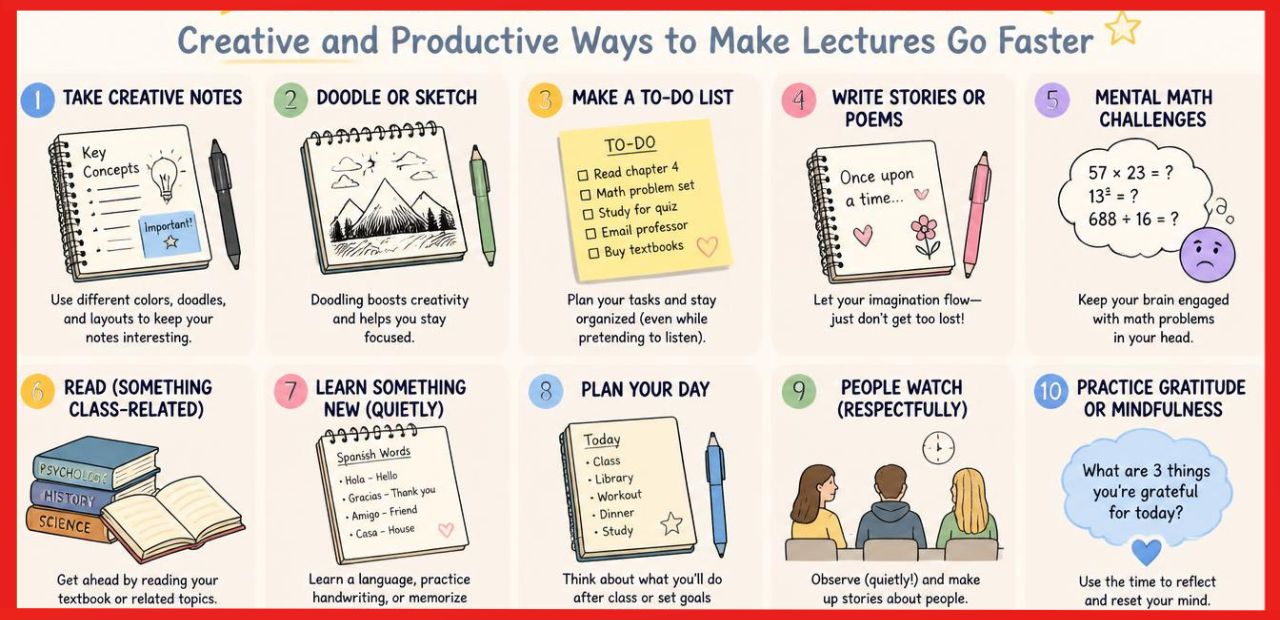
There is a strange little moment in almost every student’s life when the classroom clock appears to stop working.
The teacher is still explaining the same topic, the lecture seems to have developed its own timezone, and somehow only three minutes have passed. I’ve been there, staring at the wall like the wall owes me answers.
Learning how to pass time in class doesn’t have to mean wasting the entire period, though; with a little creativity, you can make the minutes feel lighter while still getting something useful from them.
Sometimes a boring class is simply a boring class, and pretending otherwise would be silly. But there are plenty of ways to pass time in class without annoying your classmates, disturbing the teacher, or turning your desk into a miniature amusement park.
The trick is to keep your hands, brain, or curiosity gently occupied while staying connected to what is happening around you.
Whether you want to know how to make class go by faster, how to stay busy in class, or simply how to avoid boredom in class, these ideas can help.
Some are productive, some are quietly entertaining, and a few are so simple that you may wonder why you never tried them before.
| Activity | Why It Helps |
|---|---|
| Take neat notes | Keeps you focused and improves memory. |
| Create a doodle | Reduces boredom without losing attention. |
| Summarize the lesson | Reinforces key concepts quickly. |
| Make a to-do list | Organizes tasks for later. |
| Practice handwriting | Improves writing skills while listening. |
| Solve mental math | Keeps your brain active. |
| Learn a new word | Expands your vocabulary. |
| Ask yourself questions | Boosts understanding of the topic. |
| Observe the classroom | Improves mindfulness and attention. |
| Plan your day | Makes productive use of free moments. |
Turn Ordinary Notes Into Something More Interesting

One of the easiest things to do in class is improve the notes you are already supposed to be taking. Instead of copying every sentence exactly as the teacher says it, try creative note taking that makes the information easier to understand later.
For example, use short phrases, arrows, symbols, little boxes, and headings. Notetaking becomes much less painful when your notebook starts looking like a map of your own thoughts rather than a transcript from a courtroom.
Try color coding when it actually helps you organize information. One color can mark definitions, another can highlight examples, and another can identify questions you want to review later.
These color coded notes can make revision much easier, and yes, choosing the perfect color for a definition can somehow consume five minutes very happily.
- Rewrite complicated ideas in simpler words while listening.
- Add tiny examples beside difficult concepts.
- Use arrows to connect causes with effects.
- Highlight questions you still don’t understand.
- Create a mini summary at the bottom of each page.
- Turn long paragraphs into short bullet points.
- Draw simple diagrams when the subject allows it.
- Mark important information with symbols instead of highlighting everything.
The goal isn’t to create an art exhibition. Your notes should still be useful, readable, and connected to the lesson.
Try Doodling With a Purpose
Doodling in class has a bad reputation because people often associate it with completely ignoring the lesson. But simple, purposeful doodling can sometimes help you stay mentally present, especially when your hands feel restless.
You might draw small icons beside concepts, create borders around sections, or sketch a visual representation of something being discussed.
A biology lesson might inspire a tiny cell diagram; a history lecture could become a timeline with little symbols. Suddenly your notebook has more personality than it did five minutes ago.
Just don’t let the doodle become the main event. If you find yourself drawing an entire dragon while the teacher explains something important, you’ve probably wandered a little too far from the lesson.
Experiment With Mind Mapping
If you’re looking for productive things to do in class, mind mapping is one of the better choices. Start with the main topic in the center of a page and branch out into related ideas.
For instance, if the lesson is about climate change, the central topic might branch into causes, effects, solutions, examples, and important vocabulary.
Every new connection gives your brain something to do, which can make a slow lecture feel surprisingly active.
Mind mapping is also useful for knowledge retention because you’re organizing relationships between ideas instead of simply staring at individual sentences.
Your brain gets a small puzzle to solve, and that is much more interesting than watching the clock negotiate with reality.
Use Quiet Fidgeting to Stay Comfortable

Some students concentrate better when their hands are doing something harmless. If that’s you, fidgeting in class may help you maintain focus rather than become a source of distraction.
A quiet stress ball, smooth pen, or small approved fidget toy can give restless hands somewhere to go.
A fidget spinner might work for some people too, although the clicking and spinning can become irritating if everyone around you can hear it.
The important word here is subtle. Think subtle movements, not performing a one-person circus beneath the desk.
- Keep movements quiet.
- Choose something that doesn’t demand your attention.
- Stop if it distracts you from the lesson.
- Respect classroom rules about fidget toys for students.
- Avoid anything that makes noise or attracts unnecessary attention.
The purpose is to support concentration, not replace it.
Take Tiny Mental Brain Breaks
Sometimes your brain doesn’t need entertainment; it needs ten seconds of breathing room. A short brain break can be surprisingly refreshing during a long lesson.
Look away from your notebook for a moment, relax your shoulders, take a slow breath, and notice what is happening around you. This tiny form of mindfulness can reduce mental tension and help reset your attention.
You can also silently ask yourself, “What is the teacher actually trying to explain here?” That question sounds ridiculously simple, but it can pull you back into the lesson when your mind has already travelled halfway across the planet.
Find Ways to Stay Awake Without Causing Trouble
Learning how to stay awake in class is sometimes less about excitement and more about basic body management. If your energy level is dropping, sitting completely motionless can make things worse.
Sit upright, take a sip of water if permitted, adjust your posture, and engage with your notes. If you are allowed to have snacks, a small, quiet snack can sometimes help when hunger is making concentration difficult.
Of course, food policies vary between classrooms. Nobody wants to become famous because their crunchy chips interrupted a silent exam-style activity.
Bathroom breaks can also provide a legitimate reset when you genuinely need one. Taking bathroom breaks should not become an excuse to disappear every twenty minutes, but standing up and walking briefly can help when you really need it.
Turn the Class Into a Networking Opportunity

A boring class becomes a little more interesting when you realize there are actual humans sitting around you. Talking to classmates at the appropriate time can help you build connections that become useful later.
You don’t need to walk up and announce, “Hello, let’s network.” That would be wonderfully awkward. Instead, ask a simple question about an assignment, compare notes, or discuss something from the lesson.
You may discover potential study buddies, new friends, or people who understand a difficult topic in a way you don’t.
- Ask a classmate how they understood a difficult concept.
- Offer to share notes when appropriate.
- Discuss upcoming assignments.
- Form a small study circle.
- Exchange useful study tips.
- Talk about ideas raised during the lesson.
- Connect with classmates for future projects.
Making friends in class can make the entire academic experience feel less lonely, and that matters more than people sometimes admit.
Turn Group Work Into an Advantage
When the opportunity appears, get involved in group assignments, class projects, and discussion groups instead of sitting silently and waiting for somebody else to finish everything.
Group activities naturally make time move faster because you’re switching between listening, thinking, speaking, and creating.
Even a dull subject can become more interesting when you’re solving a problem with other students.
You can volunteer for a small role, organize ideas, create a presentation outline, or help divide responsibilities.
These activities also strengthen class participation, which may benefit your overall academic performance depending on how your course is structured.
And honestly, the person who organizes the group project is often the person who knows what’s happening when everyone else is staring at each other.
Use Boring Moments for Personal Organization
Not every minute of a class requires intense intellectual effort. If the lesson has a natural pause and classroom rules permit it, you can quietly organize your academic life.
Check what assignments are due, write down upcoming deadlines, or arrange your study priorities. This is where time management for students becomes practical rather than something printed on a motivational poster.
You can make a tiny plan such as:
- Finish today’s reading.
- Review yesterday’s vocabulary.
- Start the upcoming assignment.
- Prepare questions for the next lesson.
- Set aside time for revision.
This kind of personal organization can reduce the mental clutter that follows you around all day.
Learn How to Make Time Pass Faster Without Wasting It
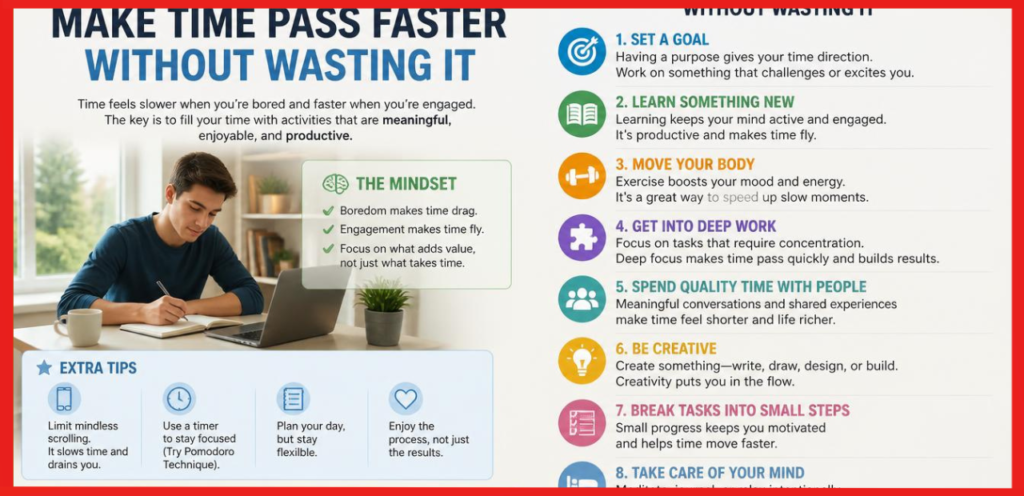
When students search for how to make time pass faster, they often imagine some secret trick that makes forty minutes disappear. Unfortunately, I don’t have a button hidden under the desk that turns a lecture into twelve minutes.
What you can do is create enough meaningful activity that you’re not constantly tracking time. Watching the clock every thirty seconds has the opposite effect. Five minutes becomes an emotional lifetime.
Instead, give yourself small targets. Listen for three key ideas. Write two useful questions. Complete one diagram. Summarize the last ten minutes. When you finish, move to another small goal.
This makes managing class time feel less like waiting and more like moving through a series of small tasks.
Use Technology Carefully
Some Apps can support productivity tracking, planning, or study organization. If your school permits devices, you might use a simple timer, task manager, notes application, or study tracker.
Searches for productivity tracking apps and tracking study time can lead you toward tools that help you understand where your study hours actually go.
Some monitoring tools, such as StaffWatcher, are designed for tracking computer activity rather than helping students learn, so they aren’t necessarily the right choice for ordinary classroom studying.
The bigger issue is temptation. Opening an app to check your assignment can quickly turn into checking messages, videos, games, and approximately seventeen things that were not part of your original plan.
Technology should support study productivity, not quietly kidnap it.
Turn the Lecture Into a Personal Challenge
Here’s a slightly strange but useful trick: treat the lecture like a challenge rather than something happening to you.
Try predicting what the teacher will explain next. Before an example is given, guess what it might be. When a new term appears, see if you can define it before checking your notes.
You can even challenge yourself to find one idea that connects today’s lesson to something you already know. This creates engagement, and engagement changes the feeling of time.
Instead of thinking, “How much longer?” you start thinking, “What happens next?”
That tiny mental shift can make a surprisingly big difference.
Avoid the Time-Wasting Trap

There is a difference between passing time and time-wasting. The first can mean making an unavoidable slow period more comfortable; the second can mean leaving class with nothing useful gained.
Constantly checking social media, playing games, whispering across the room, or inventing elaborate reasons to leave your seat may make the period disappear, but they can also damage focus, academic performance, and eventually your GPA.
If a class is genuinely boring, try giving yourself something useful to accomplish inside it. You don’t need to love every subject. Sometimes the victory is simply leaving the room knowing a little more than when you entered.
Productive Things to Do During Lectures
If you need a quick collection of activities to do during lectures, think in terms of activities that keep your brain attached to the subject.
You can summarize, question, organize, visualize, predict, compare, or connect ideas. Those six actions are enough to turn passive listening into active learning.
- Summarize the main point in one sentence.
- Write down unfamiliar vocabulary.
- Create a quick mind map.
- Add useful diagrams to your notes.
- Write one question about the topic.
- Connect today’s idea with an earlier lesson.
- Mark material that needs later review.
- Prepare a question for class participation.
These aren’t flashy activities, but they can improve retaining information while making the period feel less sluggish.
What to Do When the Class Is Truly Boring
Sometimes you’ve tried everything and the class still feels like watching paint dry while the paint gives a lecture about itself. That’s okay.
When dealing with boring classes, lower your expectations for entertainment and raise your goal for usefulness. You don’t need every lesson to be exciting. You simply need a strategy that helps you remain present.
If you’re struggling with avoiding classroom distractions, keep your phone away, sit where you can see the board clearly, and remove unnecessary objects from your desk.
If noise is an issue, focus on the teacher’s key points rather than every sound around you.
And if you’re genuinely confused, ask for clarification when appropriate. Confusion can feel boring when what you really need is a missing piece of information.
How to Stay Motivated in Class

Motivation doesn’t always arrive before the work begins. Sometimes it shows up after you’ve started.
Give yourself a reason to care about the lesson. Maybe the material connects to your future career, an upcoming exam, a personal interest, or simply the grade you want.
Academic productivity isn’t always about feeling inspired; sometimes it’s about building a habit of doing useful things even when the mood isn’t there.
Think of each class as an investment rather than a punishment. A single useful idea might not feel important today, but several months of small ideas can become a surprisingly strong foundation.
How to Pass Time in Class Without Losing Focus
The best answer to how to pass time in class is not to escape the lesson completely. Instead, make the lesson more interactive for yourself.
Take better notes. Sketch a diagram. Ask a question. Organize your thoughts. Talk to a classmate at the right moment.
Practice mindfulness when your attention wanders. Use a quiet fidget if it genuinely helps. Give yourself small targets and stop staring at the clock.
These little habits can improve classroom productivity without making you feel like you’re forcing yourself through every second.
And perhaps most importantly, remember that boredom is temporary. A forty-minute class may feel enormous while you’re sitting in it, but later it becomes just another small square on the calendar.
How to Make Class Go By Faster: A Simple Routine
If you want a practical answer to how to make class go by faster, try this routine.
At the beginning, write the date and lesson topic. During the middle, identify three important ideas and one question.
If your attention starts slipping, make a small diagram or reorganize your notes. Near the end, write a two-sentence summary.
You have now given your brain several jobs instead of one: listen, identify, organize, question, and summarize.
That is also a quiet form of time management. You’re not trying to magically speed up the clock; you’re making better use of the time the clock is already giving you.
How to Write Your Own Classroom Strategy

Every student is different, so don’t assume the same trick works for everybody. One person may love doodling, while another finds it distracting.
One student may concentrate better with a stress ball, while another spends the entire lesson squeezing it like they’re preparing for an arm-wrestling championship.
Start by noticing when your attention usually disappears. Is it during long explanations? When you’re tired? When the room is noisy? When you don’t understand the topic?
Once you know the problem, choose one strategy rather than ten at once. Test it for a few classes and see whether your concentration, engagement, and knowledge retention improve.
Frequently Asked Question
Is it okay to pass time in class without paying attention?
It’s best to stay engaged with the lesson. Choose quiet activities that don’t distract you or others.
How can I pass time in class without getting caught?
Avoid obvious distractions like using your phone. Stick to subtle, respectful activities such as doodling or organizing your notes.
What are the best quiet activities to do in class?
You can take creative notes, solve mental puzzles, plan your day, or sketch lightly while still listening to the teacher.
Can passing time in class also be productive?
Yes. Reviewing notes, brainstorming ideas, or setting personal goals can help you use class time wisely.
Should I use my phone to pass time in class?
No. Using your phone may violate school rules and distract both you and your classmates.
How do I make a boring class feel shorter?
Focus on small learning goals, participate when possible, and break the lecture into smaller parts to make time seem to pass faster.
Read this blog https://wittechyo.com/how-long-until-230/
Final Thoughts on Passing Time in Class
Learning how to stay awake in class, remain productive, and make slow lessons feel shorter doesn’t require secret tricks. Often, the simplest answer is to give your mind something meaningful to do.
Use creative note taking, try color coding, experiment with mind mapping, participate in discussions, connect with study buddies, or take a tiny brain break when your attention needs resetting. When appropriate, even quiet fidgeting or a small snack can make a long period easier.
The biggest lesson is that you don’t have to choose between boredom and disruption. There is a comfortable middle ground where you can make time feel faster while still protecting your focus, productivity, and academic performance.
So next time the clock seems frozen and the teacher is halfway through an explanation that feels longer than a winter evening, don’t surrender to the boredom just yet.
Open your notebook, find one interesting question, draw one useful connection, and give your brain a small mission.
Sometimes making a class go faster isn’t about making the clock move. It’s about giving yourself a reason to stop watching it.