

There’s a very strange kind of quiet that shows up right before a graduation ceremony begins. You can hear fabric rustling, a few shaky laughs, maybe someone whispering “is my Graduation cap sitting straight or nah?” and honestly, nobody is ever fully sure.
I still remember the moment I first wore a mortarboard it felt like it belonged to someone more serious than me, like I had borrowed a symbol of adulthood from a future version of myself who already knew what she was doing (spoiler: she didn’t really).
The tassel kept poking my eyebrow and I kept thinking, why is something so small making me feel so… big inside?And that’s the odd magic of it.
The Graduation cap size/dimensions are technically just numbers, but emotionally, they feel like a doorway. A weirdly square-shaped one.
Graduation cap size and why it actually matters
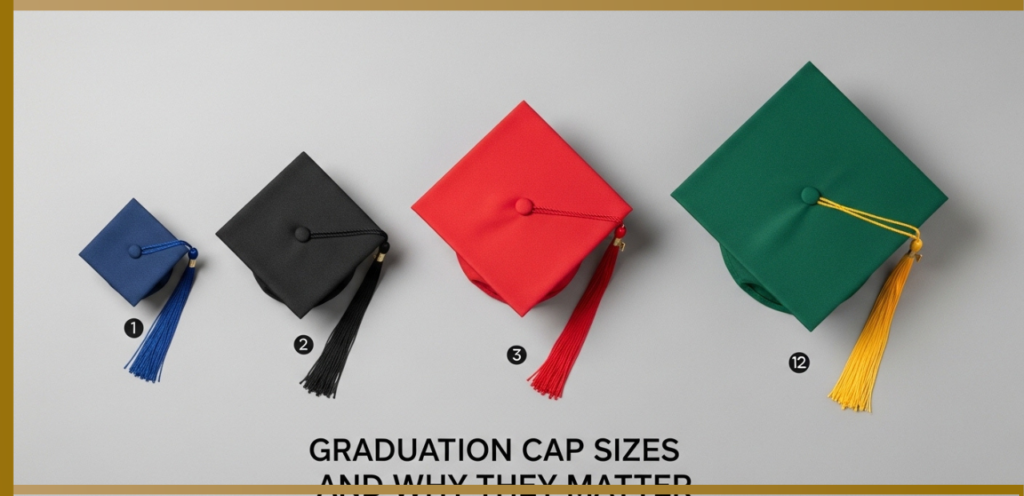
At first glance, nobody really cares about graduation cap dimensions. You’re thinking about photos, family, relief, maybe even snacks after the ceremony. But then you put it on, and suddenly the fit matters a lot more than expected.
A cap too tight feels like pressure sitting on your thoughts. Too loose, and it keeps sliding like it’s trying to escape your achievements. The standard academic cap dimensions exist for a reason, even if most people don’t think about them until the moment things feel slightly off.
The classic graduation cap square size is tied deeply to the idea of balance literally and symbolically. The flat square board sits above your head like a tiny stage for everything you’ve learned.
In old Medieval European universities, scholars and clergy wore early versions of this headwear, not as fashion, but as identity markers of learning and discipline.
Some say the shape itself represents the “square of knowledge,” a neat, controlled structure over the chaos of learning. Others just say, “it looks cool and stable,” which is also fair.
Either way, when you’re adjusting your academic regalia, it suddenly feels like you’re part of something older than your student ID ever suggested.
Graduation cap dimensions explained: standard measurements breakdown
Now let’s talk real details, the kind people Google at 2 a.m. before ceremony day.
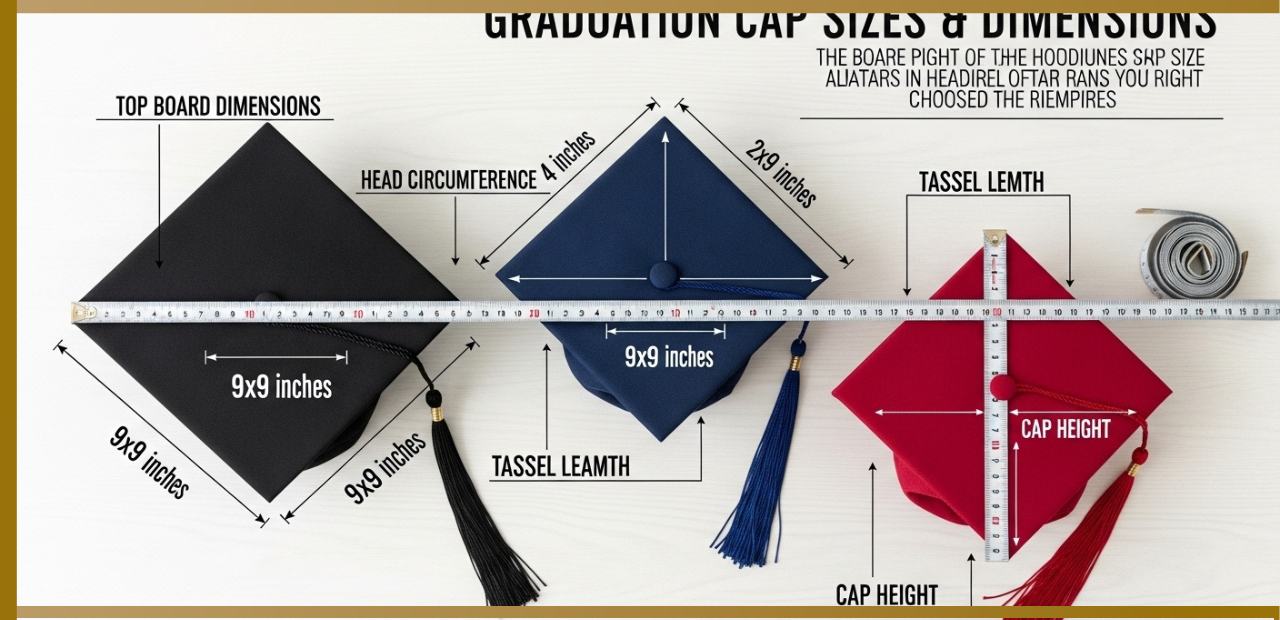
The Graduation cap dimensions are surprisingly standardized across most institutions, though tiny variations exist depending on country, manufacturer, and level of education.
Here’s a breakdown of typical measurements you’ll come across:
- The Square board (cap top) is usually around 9–10 inches (24–25 cm)
- Cap depth measurement generally sits around 3–4 inches (7.6–10 cm)
- The Plastic cap base is flexible but structured to hold shape
- Elastic headband ranges roughly 22–25 inches (56–63.5 cm)
- Tassel length graduation cap is commonly about 9 inches (23 cm)
- The Center button (tassel holder) sits right in the middle of the square top
- Fabric is usually polyester blend, with a smooth fabric covering
- Thickness is light, around 0.25–0.5 inches so it doesn’t feel heavy
- Some premium versions include reinforced stitching for wind resistance (yes, that’s a thing lol)
- The cap is designed as one size fits most graduation cap, but “most” is doing a lot of work there
Funny thing is, even though everything is standardized, your head will still somehow feel like a “special edition” size on graduation day.
Cap size chart and head circumference fitting guide
If you’ve ever wondered why your cap fits your friend perfectly but keeps sliding off your own head like it’s offended, welcome to the world of cap size chart confusion.
The truth is, most caps rely on flexible sizing rather than exact tailoring. Still, knowing your head circumference measurement helps a lot.
Here’s a simple guide-style breakdown:
- Measure around your head just above the ears for accurate head circumference for graduation cap
- Typical range fits between 21–25 inches for most students
- Adjustable graduation cap size straps exist but are often hidden inside the lining
- If your cap feels loose, a few bobby pins can secretly save your dignity
- If it feels tight, try adjusting before ceremony—don’t “tough it out,” trust me
- Hair volume (especially curls, braids, or buns) changes everything unexpectedly
- The graduation cap elastic size is forgiving, but not magical
- Some schools provide fitting days, which honestly should be taken more seriously than they are
- A slightly tilted cap is normal… even expected in photos
- “Fits most” doesn’t always mean “fits comfortably,” just realistically speaking
There’s a funny contradiction here: something so symbolic is often treated like a one-size-fits-all hat, when clearly humans are anything but.
Symbolism of mortarboard and academic regalia

The mortarboard evolution is one of those things that feels almost poetic when you dig into it. Oxford and Cambridge shaped a lot of the modern academic dress traditions we still see today.
Meanwhile, earlier versions of academic clothing can be traced back to scholars and clergy academic tradition, where learning was closely tied to religious institutions and formal robes.
The square shape of the mortarboard is often interpreted as:
- A symbol of structured thinking and logic
- A representation of intellectual balance
- A visual metaphor for academic achievement
- A reminder of discipline in education systems
And honestly, people still argue about its exact meaning.
The full academic dress history shows a slow transition from heavy robes in Continental European academic traditions to more simplified modern commencement ceremony outfit standards.
One professor once said (I’m loosely paraphrasing here), “When you wear academic headwear, you’re not just dressing for yourself, you’re dressing for centuries of learners who never got the chance you just did.”
Bit dramatic maybe, but also kind of true.The tassel turning ritual (right to left) is another emotional micro-moment. It signals transition—like a small invisible door clicking open.
Educational levels and how graduation cap size changes
Not all caps are created equal, and the differences across education levels are subtle but real.
Here’s how graduation cap size can vary depending on stage:
- Elementary school graduation cap is often softer and more adjustable, sometimes with playful colors
- Middle school graduation cap tends to be slightly sturdier but still lightweight
- High school graduation cap follows standard sizing with full cap and gown tradition
- Undergraduate graduation cap uses traditional academic regalia standards
- Graduate (Master’s) graduation cap may include slightly refined fabric and structure
- Doctoral graduation cap often replaces the mortarboard with a doctoral tam
- The doctoral tam vs mortarboard difference is mostly in shape and softness (tam is round and velvet-like)
- International variations exist in international graduation cap styles
- Some institutions use specific colors for different faculties or degrees
- Higher levels often have heavier gowns, but cap size stays similar surprisingly
Even though education levels differ so much, the cap somehow remains a shared visual language of achievement.
Cultural variations and traditions worldwide
Graduation is not the same everywhere, and neither is the cap.
In the US, the graduation ceremony attire is standardized, but in parts of Europe, especially older institutions, academic dress can be more elaborate or symbolic.
In some 19th-century academic standardization systems, universities began formalizing gowns and caps to unify student identity during ceremonies.
The contrast is interesting:
- American ceremonies lean toward uniformity and mass celebration
- British traditions emphasize formal institutional identity in education systems
- Some European universities still use variations rooted in medieval dress codes
- In some Asian institutions, modern caps are mixed with cultural garments
The symbolism remains strong everywhere though. It always circles back to symbolism of education and achievement, even if the style changes.
A student from a cultural exchange program once said, “I didn’t understand the cap at first, but when I wore it, I felt like I was borrowing a shape that means ‘you made it’ in every language.”
DIY personalization and graduation cap decoration ideas

Now this is where things get fun, slightly chaotic, and very emotional.
The trend of DIY graduation cap decoration has exploded because students want their caps to reflect personality, not just tradition.
Some creative ideas include:
- Adding quotes about educational milestone achievements
- Glitter designs reflecting future goals or dreams
- Photos of family or mentors who supported the journey
- Funny memes that only classmates understand
- Inspirational words like “I survived finals”
- Cultural patterns representing heritage or identity
- Artistic illustrations tied to personal passions
- Minimalist designs for a clean aesthetic feel
- Symbols of future careers (books, stethoscopes, coding icons)
- Floral or nature themes for softer emotional expression
The graduation cap decoration without tipping challenge is real though. Too much glue and suddenly your cap becomes aerodynamic in a bad way.
People also love custom graduation cap designs, especially when expressing personal identity in graduation customization, which honestly makes every cap feel like a tiny billboard of a life story.
Practical tips for fitting, buying, and storing your cap
Let’s be practical for a second, because emotions aside, caps still need to behave.
Here are some grounded tips:
- Always check your graduation cap fitting guide before ceremony day
- Store your cap in a flat storage box size (10-inch box) to avoid bending
- Avoid placing heavy objects on top of the square board (cap top)
- Use pins discreetly if your cap slips during movement
- Don’t over-style hair without testing cap fit first
- Keep the tassel untangled (it tangles faster than emotions on graduation day)
- If buying online, confirm graduation hat size chart details carefully
- Try cap + gown together before ceremony if possible
- Keep a backup pin or clip just in case of emergencies
- And honestly, take a deep breath before walking in… it helps more than expected
Frequently Asked Question
graduation cap dimensions
Standard graduation cap dimensions usually include a square top measuring around 9–10 inches with a cap depth of about 3–4 inches. Most caps are designed to fit comfortably while keeping the classic academic look intact.
grad cap dimensions
Typical grad cap dimensions stay nearly the same across schools, though small differences can happen depending on the manufacturer. The flat square board and elastic inner band help create a one-size-fits-most fit.
what are the dimensions of a graduation cap
If you’re wondering what are the dimensions of a graduation cap, the top board is generally 9–10 inches wide, while the tassel is often around 9 inches long. The inside band adjusts to fit different head sizes pretty easily.
dimensions of a graduation cap
The dimensions of a graduation cap are carefully balanced so the cap looks formal without feeling too heavy during long ceremonies. Most caps also use lightweight material with a thin but sturdy structure.
graduation cap size top
The standard graduation cap size top is usually a square measuring about 9 or 10 inches across. This flat top, also called the mortarboard, gives the cap its iconic academic appearance.
Read this blog https://wittechyo.com/chip-bag-sizes/
Conclusion: why this small cap feels like a big memory
In the end, the Graduation cap size/dimensions are just measurements on paper. But in real life, they hold a strange emotional weight that’s hard to explain.
It’s a square piece of fabric sitting on your head, yes—but also a marker of years, mistakes, late nights, friendships, confusion, and small victories nobody else saw.
From the traditions of Medieval European universities to modern classrooms filled with noise and light, the cap has quietly followed education’s evolution.
And when the tassel finally shifts, even for a second, it doesn’t just mark completion—it kind of whispers that you’ve crossed into something new, even if you don’t fully know what it is yet.
If you’ve ever worn one, you probably know what I mean. If you haven’t yet, well… it’s coming, and it’s going to feel a little bigger than the cap itself.