

There was a day when I stared at an electricity bill for far longer than anyone probably should. It had numbers everywhere, little abbreviations, and enough mystery to make it feel like a puzzle instead of a monthly statement.
I kept wondering why one appliance rated at 2 kW didn’t simply “use 2 kWh.” Then someone quietly explained that power and energy are cousins, not twins.
That tiny conversation changed how I looked at every heater, air conditioner, and electric kettle in my house.
Funny enough, it also made me realize that understanding electricity isn’t reserved for engineers its for anyone who flips a light switch.
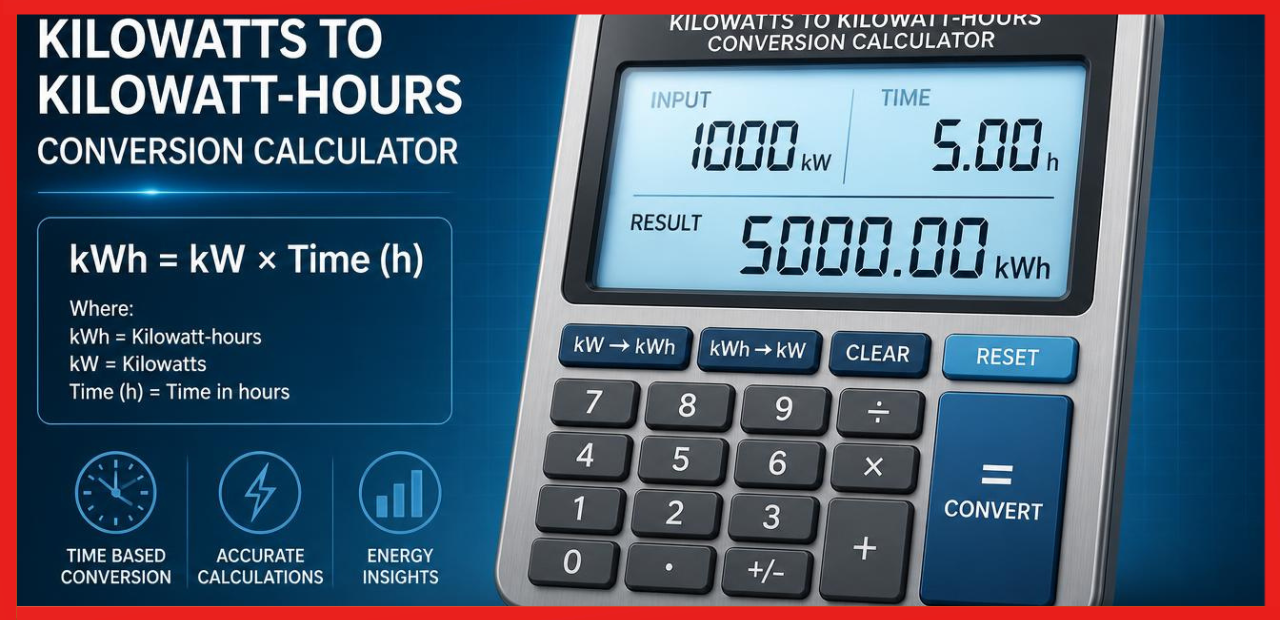
A Kilowatts (kW) to Kilowatt-Hours (kWh) Conversion Calculator takes away that confusion. It helps transform a power rating into the amount of energy actually consumed over a period of time.
Whether you’re checking electricity usage, estimating appliance costs, planning solar panels, or studying electrical engineering, understanding this conversion makes daily life just a bit smarter.
In this guide, we’ll explore the relationship between Electrical power and Electrical energy, explain the formulas in plain English, work through real-world examples, and share practical tips that make energy measurement feel surprisingly simple.
Kilowatts (kW) to Kilowatt-Hours (kWh) Conversion Calculator
The formula is:
kWh = kW × Hours
| Power (kW) | Time (Hours) | Energy (kWh) |
|---|---|---|
| 0.5 | 1 | 0.5 |
| 1 | 1 | 1 |
| 2 | 3 | 6 |
| 3 | 5 | 15 |
| 5 | 4 | 20 |
| 7.5 | 2 | 15 |
| 10 | 8 | 80 |
| 15 | 6 | 90 |
| 20 | 10 | 200 |
| 50 | 24 | 1,200 |
Formula: kWh = kW × Time (hours)
What Are Kilowatts (kW)?
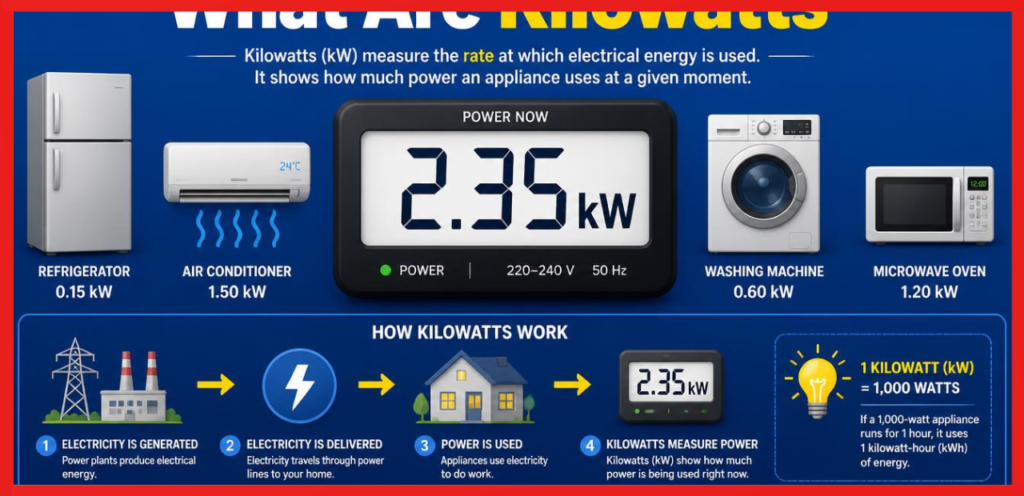
A Kilowatts (kW) value represents Electrical power. Think of it as how quickly electricity is being used or delivered at any given moment.
It doesn’t tell you how much energy has been consumed overall it simply describes the rate.One kilowatt equals 1,000 watt (W). Larger electrical installations may even use megawatt (MW) as a measurement.
Examples include:
- An electric heater rated at 2 kW.
- A water pump with a Power rating of 5 kW.
- A commercial generator producing 250 kW.
- Solar panels delivering varying Power output during daylight.
This is a Power measurement, not an Energy measurement, and that little distinction matters more than people often think.
Understanding Kilowatt-Hours (kWh)
If kilowatts describe speed, then Kilowatt-hours (kWh) describe distance—except instead of distance, we’re measuring Electrical energy.
A Kilowatt-hours (kWh) value represents the total Energy used over time.
For example:
- Running a 1 kW heater for 1 hour uses 1 kilowatt-hour.
- Running the same heater for 5 hours uses 5 kWh.
- Running a 5 kW machine for 2 hours consumes 10 kWh.
Electric utility companies charge customers based on Energy consumption, not simply on the appliance’s power rating.
That’s why your monthly electricity bill lists kWh rather than kW.
Why kW to kWh Conversion Calculator Matters
A good kW to kWh Conversion Calculator removes the guesswork from Electrical calculations.
It helps homeowners:
- Estimate appliance operating costs.
- Compare different electrical appliances.
- Monitor Energy consumption.
- Improve Energy efficiency.
- Reduce unnecessary electricity waste.
Businesses rely on the same calculations for:
- Equipment planning.
- Factory energy audits.
- Utility power forecasting.
- Load management.
- Budget preparation.
Students also use these calculators while learning electrical engineering calculations and electrical formulas.
The Simple Formula Behind the Conversion
Fortunately, the mathematics isn’t scary at all.
The standard Conversion formula is:
E(kWh) = P(kW) × T(hours)
Where:
- E = Energy
- P = Power
- T = Time
This famous Energy equation forms the basis of almost every Power to energy conversion.
If:
- 1 kilowatt
- runs for
- 1 hour
Then:
- Energy equals 1 kilowatt-hour
Simple, almost suspiciously simple.
How to Convert kW to kWh
When people ask how to convert kilowatts to kilowatt-hours, they’re really asking how long something operates.
Follow these steps:
- Find the appliance’s Power rating in kW.
- Determine the Time in hours or Hours (hrs) it operates.
- Multiply the two numbers.
- The answer is your Energy consumed.
This process works for nearly every Power conversion calculator, Energy calculator, and Electricity calculator.
kW to kWh Conversion Examples
Let’s look at some realistic calculations.
Example 1
Power = 3 kW
Time = 5 hours
Energy:
3 × 5 = 15 kWh
Example 2
Power = 8 kW
Time = 12 hours
Energy:
8 × 12 = 96 kWh
Example 3
Power = 25 kW
Operating time = 4 hours
Calculation:
25 × 4 = 100 kWh
This classic kWh calculation example demonstrates how Power consumed over time becomes measurable energy.
Kilowatts (kW) to Kilowatt-Hours (kWh) Conversion Calculator in Everyday Life
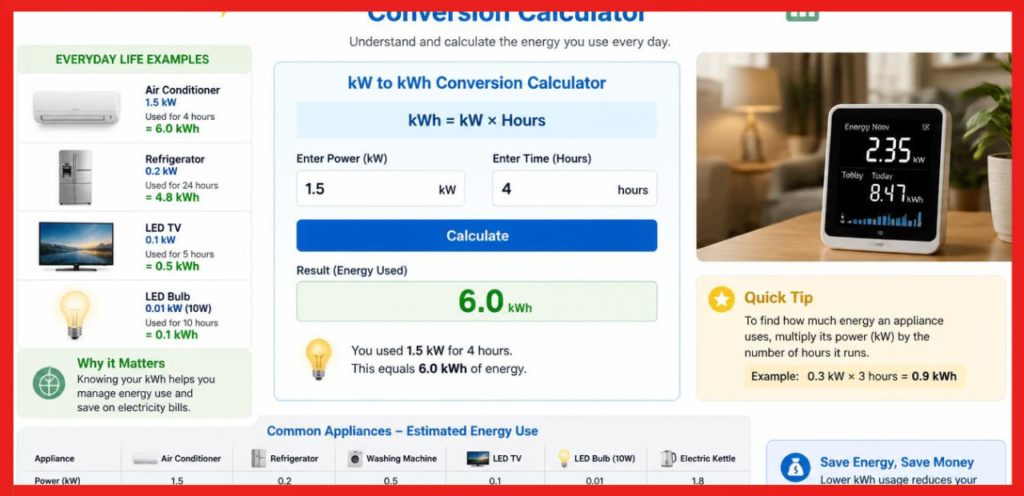
People often don’t notice they’re performing this conversion mentally.
Consider these examples:
| Appliance | Power | Time | Energy Used |
|---|---|---|---|
| Air conditioner | 2.5 kW | 8 hrs | 20 kWh |
| Electric oven | 3 kW | 2 hrs | 6 kWh |
| Water heater | 4.5 kW | 3 hrs | 13.5 kWh |
| Washing machine | 1 kW | 1.5 hrs | 1.5 kWh |
| EV charger | 7 kW | 6 hrs | 42 kWh |
These calculations help estimate Electric bill calculation before the bill even arrives.
Difference Between Power and Energy
People mix these two up all the time. Honestly, almost everyone does.
Power describes how fast electricity is being used.
Energy describes how much electricity has actually been consumed.
Think about water.
Power is like how fast water flows from a tap.
Energy is the total amount collected in the bucket.
That’s exactly how Power equation and Energy equation relate.
Why Time Changes Everything
Imagine leaving a lamp on.
If it operates for 30 minutes, it uses less energy than if it stays on for ten hours.
The Time duration is just as important as the power itself.
That’s why every Energy usage calculation includes operating time.
Without time, Power measurement cannot become Energy measurement.
Understanding Electricity Bills

Your electricity provider measures Electricity usage using an Electricity meter.
The meter records total Electricity consumption in kWh.
It doesn’t care whether the electricity came from:
- heaters,
- air conditioners,
- refrigerators,
- gaming computers,
- washing machines,
- lighting systems.
Everything eventually contributes to your total Energy usage.
Kilowatts (kW) to Kilowatt-Hours (kWh) Conversion Calculator for Homeowners
A homeowner can use a Conversion calculator to estimate monthly energy costs before receiving the utility bill.
Suppose:
- Air conditioner = 2 kW
- Runs 10 hours daily
Daily usage:
20 kWh
Monthly usage:
20 × 30 = 600 kWh
Suddenly the electricity bill doesn’t seem mysterious anymore.
Using the Calculator for Solar Systems
Solar designers constantly perform Power to energy conversion.
Suppose a solar array generates:
6 kW
Average sunlight:
5 hours
Daily energy:
6 × 5 = 30 kWh
This helps determine whether a solar installation can meet household Energy demand.
Industrial Applications

Factories depend heavily on accurate Energy consumption calculator results.
Large motors, compressors, production lines, and HVAC equipment operate for long periods.
Engineers calculate:
- Power demand
- Energy demand
- Continuous power
- Average power
- Power consumption over time
These calculations influence operating budgets worth thousands or millions of dollars.
Conversion Table
Here’s a quick Conversion table for common values.
| Power (kW) | Time (hrs) | Energy (kWh) |
|---|---|---|
| 1 | 1 | 1 |
| 2 | 3 | 6 |
| 3 | 5 | 15 |
| 5 | 8 | 40 |
| 10 | 4 | 40 |
| 15 | 2 | 30 |
| 20 | 5 | 100 |
| 25 | 4 | 100 |
This serves as a handy energy conversion chart for quick reference.
Common Mistakes People Make
Even experienced homeowners occasionally get these wrong.
Some frequent mistakes include:
- Confusing kW with kWh.
- Forgetting to include operating time.
- Using minutes instead of hours without converting.
- Assuming high power always means high monthly cost.
- Ignoring standby electricity usage.
A tiny mistake can make your estimated bill wildly inaccurate.
Related Electrical Conversion Calculators
Many people searching for this calculator also use other tools.
Popular examples include:
- kWh to kW calculator
- Watts to kWh calculator
- Power conversion calculator
- Electric current conversion calculator
- Power unit converter
- Energy unit converter
- Amps to Kilowatts calculator
- Watt-hours to Amp-hours calculator
- Amp-hours to Watt-hours calculator
- Other Electrical conversion calculators
Together, these tools simplify nearly every type of electrical unit conversion.
Improving Energy Efficiency
Understanding your Energy usage naturally encourages smarter habits.
A few ideas include:
- Replace older appliances with efficient models.
- Turn off equipment when not needed.
- Monitor Hourly energy usage.
- Upgrade insulation.
- Install programmable thermostats.
- Track consumption using smart meters.
- Reduce unnecessary standby loads.
Small improvements often add up to surprisingly noticeable savings. Funny thing is, many families don’t even realize where most of their electricity quietly disappears until they begin measuring it.
Frequently Asked Questions
How many kWh is 1 kW?
A 1 kilowatt appliance uses 1 kilowatt-hour only when it operates for 1 hour.
Can I calculate kWh from watts?
Yes. Convert watt (W) into kilowatts by dividing by 1,000, then multiply by the operating hours.
Why does my electricity bill use kWh instead of kW?
Utility companies charge for total Energy consumed, not instantaneous power.
Is this formula used worldwide?
Yes. The equation E(kWh) = P(kW) × T(hours) is the internationally accepted method for calculating electrical energy.
Does running an appliance longer increase energy use?
Absolutely. Greater Operating hours directly increase total Energy consumption.
Frequently Asked Question
kw to kwh calculator
A kW to kWh calculator helps you determine how much electrical energy is used over a specific period. Simply enter the power in kilowatts and the operating time in hours to calculate the energy in kilowatt-hours.
kilowatt to kilowatt-hour
A kilowatt (kW) measures power, while a kilowatt-hour (kWh) measures energy consumed over time. You can convert kW to kWh by multiplying the power by the number of hours the device operates.
kw to kwh
To convert kW to kWh, use the formula: kWh = kW × Hours. For example, a 2 kW appliance running for 5 hours uses 10 kWh of energy.
convert kw to kwh
To convert kW to kWh, multiply the appliance’s power rating in kilowatts by its operating time in hours. This calculation shows the total energy consumed during that period.
kilowatts to kilowatt hours
Converting kilowatts to kilowatt-hours is essential for estimating electricity usage and energy costs. The conversion depends on how long the equipment runs, using the formula kWh = kW × Hours.
Read this blog https://wittechyo.com/calculate-cubic-yards/
Final Thoughts
Learning the relationship between Kilowatts (kW) and Kilowatt-hours (kWh) is one of those surprisingly practical skills that sticks with you.
At first, the abbreviations can look like alphabet soup, but after a few examples, the logic begins to feel almost obvious.
Power tells you how fast electricity is being used, while energy tells you how much has actually been consumed over time.
Whether you’re using a kW calculator, kWh calculator, electricity usage calculator, power consumption calculator, or a complete energy conversion calculator, the same principle always applies: multiply power by time.
That simple idea sits at the heart of electrical energy conversion, electricity calculations, and countless real-world decisions, from estimating household bills to designing large industrial electrical systems.
The next time you switch on an appliance, you might find yourself wondering not just how powerful it is, but how much energy it’s quietly collecting on your electricity meter while the hours drift by.
Oddly enough, that’s when numbers stop feeling cold and begin telling a story about the way we use energy every single day.