

There is something oddly beautiful about welcoming a baby girl into the world. The room changes in ways that no paint color could ever explain.
Somebody laughs softer, somebody cries louder, and suddenly even the ticking clock sounds like it learned patience. I remember hearing a grandmother once whisper, “A daughter doesn’t only arrive, she quietly rearranges everyone’s heart.” That sentence stayed with me longer than I expected, maybe becuase it felt true in a way numbers never could.
Now, this article isn’t about newborn blessings, and yet that gentle beginning reminds us of something important. Life is full of measurements.
Parents measure baby formula, doctors measure medicine, bakers measure ingredients for celebration cakes, and scientists measure chemicals that shape tomorrow.
Behind many of these everyday moments sits one surprisingly common question: How do you convert milligrams to milliliters? Funny enough, a tiny unit conversion can sometimes matter just as much as a giant life event.
If you’ve ever stared at a medicine bottle wondering why the prescription says Milligrams (mg) while the syringe shows Milliliters (mL, ml, mℓ), you’re not alone.
It feels almost like two people speaking different languages while expecting the same answer. Thankfully, once you understand Mass, Volume, and Density, everything starts fitting together kinda naturally.
| Milligrams (mg) | Milliliters (mL) |
|---|---|
| 1 mg | 0.001 mL |
| 10 mg | 0.01 mL |
| 50 mg | 0.05 mL |
| 100 mg | 0.1 mL |
| 250 mg | 0.25 mL |
| 500 mg | 0.5 mL |
| 750 mg | 0.75 mL |
| 1,000 mg (1 g) | 1 mL |
| 2,000 mg | 2 mL |
| 5,000 mg | 5 mL |
| 10,000 mg (10 g) | 10 mL |
Why Milligrams and Milliliters Are Not the Same Thing
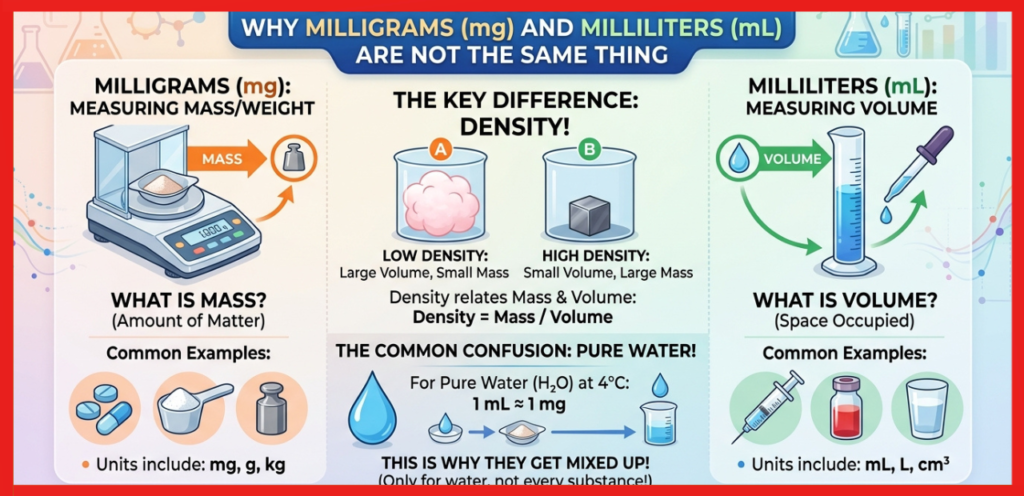
One of the biggest misunderstandings is believing that Weight and liquid volume can simply replace each other. They cant.
A Milligram (mg) measures Mass. A Milliliter (mL) measures Volume. They belong to different families of measurements inside the Metric system and the internationally recognized SI units.Think of it like this.
Imagine holding a feather and a pebble. Both might occupy roughly the same space, yet one weighs much more. Space and weight are related, but they are never identical. That strange little relationship is exactly why Milligrams to milliliters conversion always depends on something else.
That “something else” is Density (g/mL) or Density (mg/mL).Without density, converting milligrams into milliliters is like trying to count songs using inches. The question itself misses an important piece.
Understanding the Core Units
Before jumping into the Unit conversion, let’s quickly understand the measurements involved.
- Milligrams (mg) represent one-thousandth of a Gram (g).
- One Gram (g) equals 1,000 milligrams.
- One Kilogram (kg) equals 1,000 grams.
- One Liter (L) equals 1,000 milliliters.
- One Milliliter (mL) is equal to one Cubic centimeter (cc, cm³).
- Larger engineering fields may occasionally mention Cubic inches, although healthcare and laboratories rarely do.
- Older systems sometimes reference Grains, especially in historical pharmaceutical documents.
The prefix Metric prefix (milli) simply means Thousandths (10⁻³). Once you understand that tiny prefix, dozens of metric conversions suddenly become less scary.
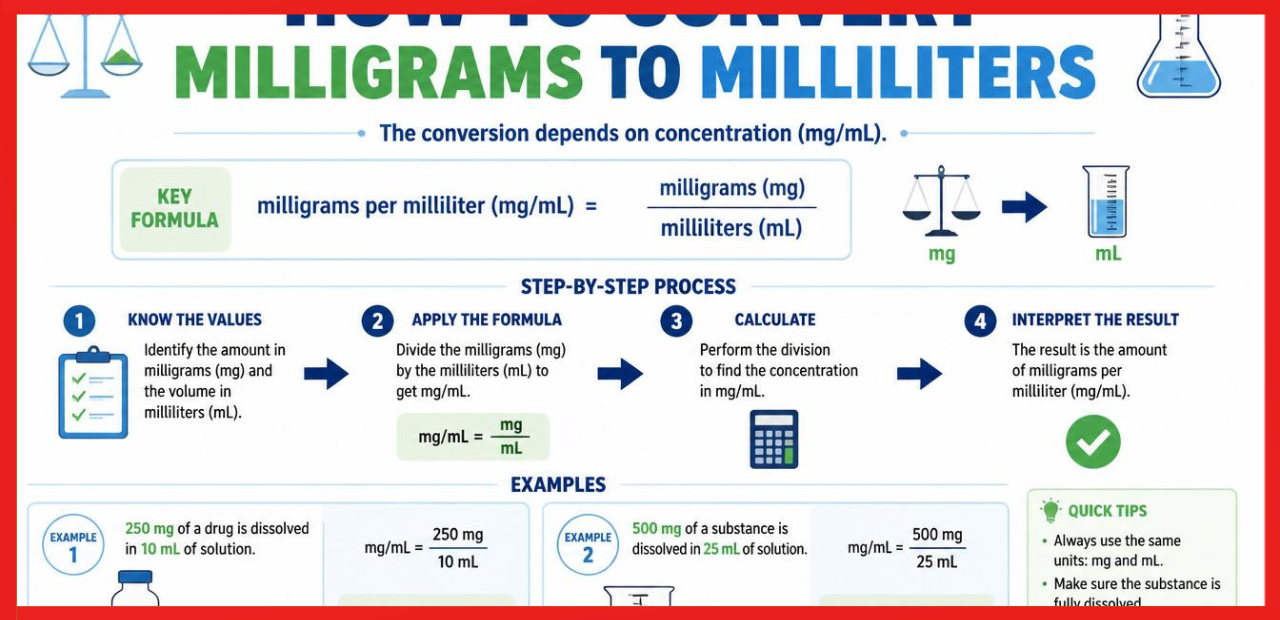
The Milligrams to Milliliters Conversion Formula
Here’s the formula you’ll use almost every time.
Milliliters = Milligrams ÷ Density (mg/mL)
Or written another way:
mL = mg ÷ mg/mL
This simple Conversion formula forms the basis of almost every Measurement conversion, Weight to volume conversion, and many pharmaceutical calculations.
Suppose a medicine has a concentration of 250 mg/mL.
You need 500 mg.
500 ÷ 250 = 2 mL
So:
500 mg = 2 mL
Notice something important? The answer depended entirely on the medicine’s concentration.
If that concentration changed, the answer would also change. Thats why asking “How many ml is 500 mg?” without mentioning density can never produce one universal answer.
Why Density Changes Everything
The hero of every Density conversion is, well, density.Density tells us how much mass exists inside a certain volume.Different materials have different Material density, Substance density, and physical behavior.
For example:
- Water has a density of water close to 1 g/mL.
- Milk has a slightly higher density of milk.
- Cooking oil has a lower density of cooking oil.
- All-purpose flour has a different density of flour.
- Granulated sugar has its own density of sugar.
That means identical weights may occupy different amounts of space.A spoonful of sugar simply doesn’t behave like a spoonful of oil. They don’t read the same invisible rulebook.
How to Convert Milligrams to Milliliters for Medicine
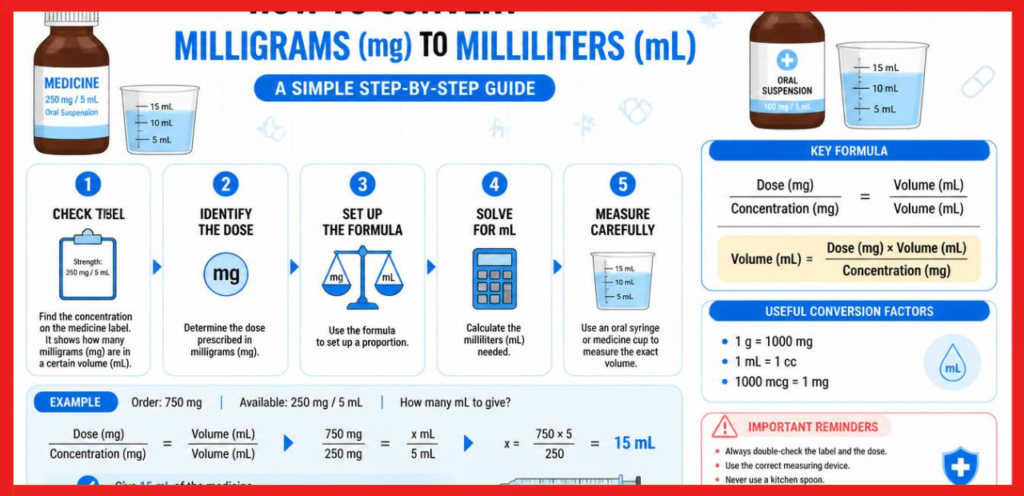
Medical dosing is probably where people search for convert mg to ml for medicine most often.
Imagine a prescription says:
- Required dose: 400 mg
- Bottle concentration: 200 mg/mL
Calculation:
400 mg ÷ 200 mg/mL = 2 mL
The patient should receive 2 mL.
Another example:
Prescription:
- 150 mg
- Suspension strength: 50 mg/mL
150 ÷ 50 = 3 mL
Answer:
3 mL
This is why Medication dosage, Drug dosage, Medical dosing, medicine dosage conversion, and pharmaceutical measurements always rely on concentration rather than guessing.
Professional Doctors and Pharmacists never assume mg equals mL automatically. They verify concentration every single time.
Milligrams to Milliliters Conversion in Chemistry
Inside chemistry laboratories, conversions become even more important.Whether calculating Mass-volume stoichiometry, preparing Chemical reactions, measuring Chemicals, handling Powdered chemicals, or working with Aqueous chemicals, precision matters.
Imagine preparing a solution with:
- Required chemical = 2,500 mg
- Density = 500 mg/mL
Calculation:
2,500 ÷ 500 = 5 mL
Small mistakes during Laboratory calculations may affect the entire Yield of reaction, which is why laboratory workers rely on Scientific measurements, Chemistry calculator tools, and verified formulas instead of estimation.
How Cooking Uses Weight to Volume Conversion
Not everyone realizes that kitchens quietly perform chemistry every single day.Professional Chefs often switch between Cooking ingredients, Baking ingredients, and Dry ingredients, constantly balancing measuring by weight and measuring by volume.
Consider these examples:
- Water
- Milk
- Cooking oil
- All-purpose flour
- Granulated sugar
Each ingredient has a different density.
That means a Cooking conversion chart, ingredient conversion chart, cooking ingredient density chart, or baking ingredient conversion guide becomes much more reliable than random internet guesses.
Many experienced bakers actually prefer using a Kitchen Scale, Digital scale, and direct weight measurements because they’re usually more consistent than cups or spoons.It’s kinda funny really cakes seem to remember every shortcut you take.
Helpful Conversion Examples
Here are several practical examples.
If density = 1 mg/mL
- 100 mg = 100 mL
- 250 mg = 250 mL
- 500 mg = 500 mL
If density = 100 mg/mL
- 100 mg = 1 mL
- 250 mg = 2.5 mL
- 500 mg = 5 mL
- 1,000 mg = 10 mL
Notice how dramatically the answers changed.
That’s why every accurate weight to volume conversion begins with density.
Milliliters to Milligrams Conversion
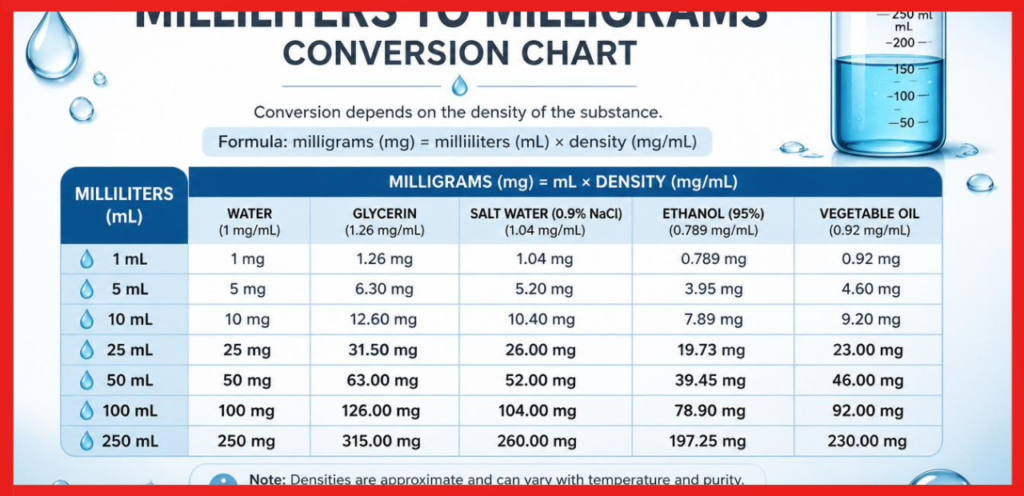
Sometimes the opposite calculation is needed.
Instead of Milligrams to milliliters conversion, you’ll perform Milliliters to milligrams conversion.
Formula:
Milligrams = Milliliters × Density (mg/mL)
Suppose:
Volume = 10 mL
Concentration = 250 mg/mL
10 × 250 = 2,500 mg
This type of Volume to weight conversion appears constantly in hospitals, pharmacies, chemistry labs, and food manufacturing.
Common Conversion Tools
Fortunately, modern technology makes life easier.
Useful tools include:
- mg to ml calculator
- weight to volume converter
- volume to weight calculator
- measurement calculator
- conversion calculator
- unit conversion calculator
- metric conversion calculator
- density calculator
- scientific calculator
These calculators reduce arithmetic mistakes while speeding up precision measurements.Still, even the smartest calculator cannot invent density if you don’t provide it.
Related Metric Conversions Worth Knowing
Understanding one conversion often opens the door to many others.
Common examples include:
- grams to milliliters
- kilograms to milliliters
- milligrams to liters
- milligrams to grams
- milligrams to kilograms
- milligrams to ounces
- milligrams to pounds
- ounces conversion
- pounds conversion
- liter conversion
- gram conversion
- kilogram conversion
- fluid ounces to milliliters
- teaspoons to milliliters
- tablespoons to milliliters
- cups to milliliters
- pints to milliliters
- quarts to milliliters
- gallons to milliliters
These conversions appear across medicine, nutrition, engineering, and everyday cooking more often than people realize.
The Science Behind Measurement

The reason these formulas work is grounded in physical science.Organizations like the National Institute of Standards and Technology (NIST) help define reliable measurement standards used worldwide.
Educational resources such as the CK-12 Foundation also explain metric measurement, SI measurement units, and scientific calculations in accessible ways.
Whether you’re standing on Earth or imagining experiments on the Moon, the relationship between mass, volume, and density follows the same scientific principles, although weight itself changes with gravity.
It’s one of those beautiful little reminders that mathematics doesn’t really care where your shoes happen to be standing.
Frequently Asked Questions
Can I convert mg directly into mL?
Not unless you know density or concentration.
Is 500 mg always equal to 5 mL?
No.
It depends entirely on the Density (mg/mL) of the substance.
Is one mL always one gram?
Only approximately for pure water under standard conditions.
Other liquids differ.
Why do medicine bottles show mg and mL?
Because one tells you the amount of active ingredient, while the other tells you the volume you’re measuring.
Is mL the same as cc?
Yes.
One Cubic centimeter (cc, cm³) equals one milliliter.
Practical Tips for Accurate Measurement
Whether you’re measuring medicine, baking ingredients, or laboratory chemicals, a few habits make a surprising difference.
Always read labels twice before calculating. Check the concentration carefully rather then assuming it matches another bottle sitting nearby.
Use clean measuring equipment, especially when working with liquids. Prefer a calibrated syringe for medicine and a Digital scale for dry ingredients whenever possible.
Keep an ingredient measurement guide, metric conversion chart, or conversion reference table close by if you perform these calculations regularly. They save time, and maybe a little frustration too.
When working in laboratories, double-check every calculation before preparing solutions. Scientists often verify each other’s work not because they lack confidence, but because precision deserves company.
Frequently Asked Question
## mg to ml
To convert mg to mL, you must know the density or concentration of the substance. The basic formula is: mL = mg ÷ (mg/mL).
## milligrams to milliliters
Milligrams to milliliters conversion isn’t direct because milligrams measure weight (mass) while milliliters measure volume. The substance’s density determines the correct result.
## ml to mg conversion
For mL to mg conversion, multiply the volume in milliliters by the substance’s concentration or density: mg = mL × (mg/mL).
## 10 mg to ml
The value of 10 mg to mL depends on the concentration. For example, if a liquid has a concentration of 10 mg/mL, then 10 mg = 1 mL.
## mg to ml converter
An mg to mL converter quickly calculates volume from weight using the substance’s density or concentration, making medication, cooking, and laboratory measurements more accurate.
Read this blog https://wittechyo.com/16-weeks-from-today/
Final Thoughts
Learning how to convert milligrams to milliliters is much less about memorizing one magical number and much more about understanding relationships. Mass, Volume, and Density dance together in a quiet little triangle, and once you see the pattern, conversions become almost friendly.
Whether you’re calculating mg to mL conversion with density, preparing medication, following a recipe, completing chemistry conversions, or simply satisfying your curiosity, the key lesson never changes: always know the density first.
The next time someone asks, “How many ml is 500 mg?”, you’ll know the smartest answer isn’t a number. It’s a question.
“What’s the density?”
That tiny follow-up can make all the difference between an accurate calculation and a very wrong guess. And somehow, that’s a lovely reminder that the best answers in life often begin with understanding the whole story before rushing toward the conclusion.